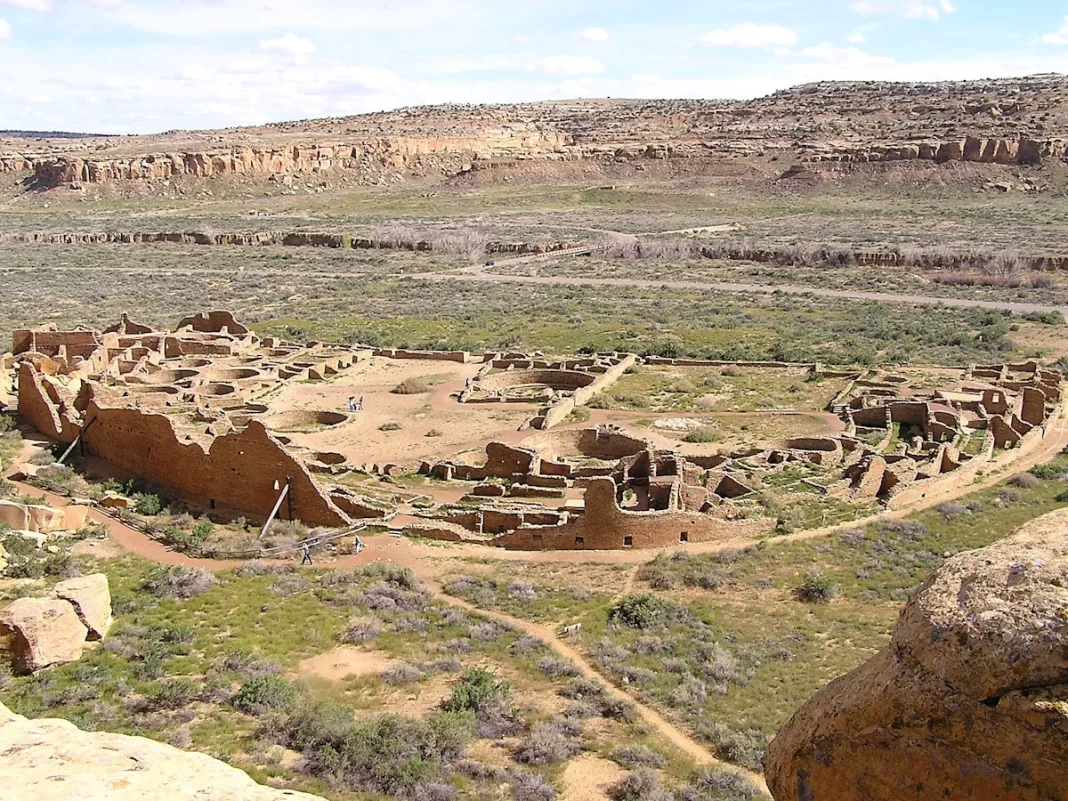

The Bureau of Land Management plans to reopen the area around Chaco Culture National Historical Park for possible oil and gas leasing, and will give the public 14 days to comment on the proposal.
In April, the Interior Department moved to revoke protections surrounding Chaco Culture with a proposal to rescind Public Land Order 7923, which put wide areas of land around the park off limits to mining and drilling.
The BLM has now opened a 14-day comment period for the draft Environmental Assessment for Proposed Revocation of Public Lands Order 7923. Comments are due July 29.
The move came just days after President Donald Trump slashed the boundaries of two Utah national monuments, Bears Ears and Grand Staircase-Escalante national monuments, by nearly 3 million acres. Both are important to tribes in the region.
Revoking the protections would undo action taken in June 2023 by then-Interior Secretary Deb Haaland, who withdrew more than 336,400 acres of public land from mining and drilling, creating a 10-mile buffer around the park for 20 years. The new proposal would return discretion over mineral leasing to the Bureau of Land Management and reopen the land to new claims and development.
The BLM’s announcement drew harsh comments from opponents of the plan.
“Don’t allow protection that took decades to build to be reversed with the stroke of a pen,” said All Pueblo Council of Governors Chairman Joey Sanchez of the Pueblo of Santa Ana. “We said that in May. We are saying it again today, and the Department has now put in writing exactly what it intends. It intends to erase all of it, and it has given the public two weeks to object.”
Cultural site: Chaco Canyon listed as ‘endangered’ as tribes, feds spar over drilling
Inventory of cultural resources is ‘incomplete’
In May, Greater Chaco Cultural Landscape was named by the National Trust for Historic Preservation one of America’s 11 Most Endangered Historic Places for 2026. Chaco Canyon, in western New Mexico, was nominated by the Pueblo of Acoma and supported by the All Pueblo Council of Governors to protect the ancestral land of modern Pueblo tribes and the origins of several Navajo clans.
Sanchez also pointed to the BLM’s own findings, which acknowledge that its inventory of cultural resources within the 10-mile buffer remains incomplete. According to the document, the area contains at least 7,552 known historic properties and 145 traditional cultural properties, but those numbers represent only a fraction of what exists because large portions of the region have never been formally surveyed.
The report also states that the number of traditional cultural properties is a minimum estimate, as previous studies were not comprehensive and the BLM does not have access to all available information. It further notes that the broader cultural landscape itself has not been documented as a historic property.
“The Department is proposing to remove protection from a place it admits it has not finished looking at, using knowledge it admits it does not have,” said Sanchez. “Our Pueblos hold that knowledge. We have been asked for it, and we have given it, in good faith, over many years, because we were told it would matter to decisions exactly like this one. It is not in this document. What is missing is not a technicality. It is the substance of what makes this landscape what it is.”
The All Pueblo Council of Governors, which represents the 20 sovereign Pueblo nations of New Mexico and Texas, has voiced its opposition to revoking Public Land Order 7923. The Navajo Nation, however, continues to oppose the 10-mile buffer zone around Chaco Culture National Historical Park.
During a Navajo Nation presidential forum, Speaker Crystalyne Curley, who is running for president, said the Navajo Nation’s position against the buffer zone remains unchanged.
“First and foremost there, we approved the resolution for a zero buffer zone, and that position is still in place for the Navajo Nation today,” said Curley. “The families that are holding allotment lands here: You should be having the ability the opportunity to say what you want to do with your land. As Navajo people, we have been long taking care of Chaco Canyon. No one should be telling us that we are not taking care of our sacred sites.”
Contrasting opinions: Tribal leaders rally support for Chaco Canyon, citing threats from Trump energy policies
BLM will prepare environmental review of plan
Less than a week before Haaland’s tenure as the nation’s first Native American secretary of the Interior came to an end, the Navajo Nation filed a lawsuit in federal court in New Mexico challenging the Interior Department’s decision to withdraw land from future oil and gas leasing around Chaco Culture National Historical Park. The tribe argued the withdrawal violated federal law and could cost Navajo land allottees millions of dollars in royalty revenue. On March 31, the lawsuit was dismissed without prejudice, allowing the Navajo Nation the option to refile the case.
Revocation of the withdrawal would restore discretion over mineral leasing to the BLM and would re-open that public land to location and entry under the U.S. mining laws.
The BLM will prepare an environmental assessment examining three alternatives: keeping the current 10-mile withdrawal around Chaco Culture National Historical Park in place, fully revoking the withdrawal and reopening all 336,404 acres to new mining and oil and gas leasing, or partially revoking it by maintaining a 5-mile buffer while reopening lands beyond that area to development.
The public can submit comments before the July 29 deadline. Comments may be submitted through the BLM National NEPA Register at eplanning.blm.govunder DOI-BLM-NM-F010-2026-0002-EA.
Arlyssa D. Becenti covers Indigenous affairs for The Arizona Republic and azcentral.com. Send story ideas and tips to arlyssa.becenti@arizonarepublic.com.
This article originally appeared on Arizona Republic: BLM fast-tracks proposal to open Chaco Canyon to oil and gas drilling