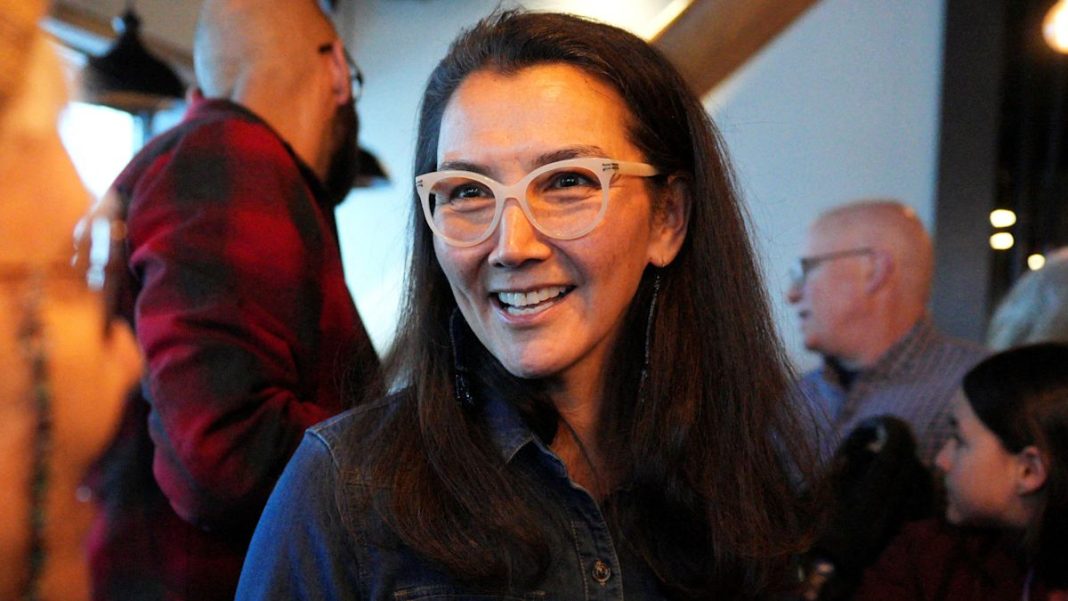

Four Alaska Senate candidates will advance to the general election after the state’s nonpartisan “jungle” primary on Tuesday. But Democrat Mary Peltola is the one everybody’s buzzing about.
From 2022 to 2025, Peltola was the first Alaska Native and the first woman to represent the Last Frontier in Congress. Now she’s trying to help Democrats recapture control of Congress by toppling incumbent Republican Sen. Dan Sullivan in a state that voted for President Trump three times in a row.
On Tuesday, Peltola took another step toward her goal, leading Sullivan 48% to 43% in Alaska’s provisional primary tally, with 80% of precincts reporting. A third-place candidate and fourth-place candidate will also appear on November’s ballot, but they currently trail the frontrunners by more than 40 points. Ultimately, Alaska is looking like a two-horse race.
That Peltola may have the upper hand says a lot about her unique approach to politics.
“The reason Mary Peltola has a chance is not because, necessarily, Democrats are surging in Alaska,” Scott Kendall, an election law attorney who has worked for candidates of both parties, including Sen. Sullivan, recently told the Guardian. “It’s that Mary Peltola, you know, she’s very pro-oil and gas development. She’s good on issues that matter to Alaskans’ pocketbooks, and that makes her just a bit of a unicorn.”
Peltola is “a different type of Democrat,” Brandon Boylan, a political science professor at the University of Alaska Fairbanks, told USA Today.
Here’s everything you need to know about Mary Peltola, who is likely to be one of the key figures of the 2026 midterms.
Who is Peltola?
Peltola, 52, was born Mary Sattler in Anchorage, Alaska, in 1973. Peltola’s father was Ward Sattler, a German-American transplant from Nebraska who moved to Alaska to work as a pilot and teacher; Peltola’s mother, Elizabeth “LizAnn” Piicigaq Williams, is Yup’ik — one of several Indigenous groups in western and southwestern Alaska.
Peltola grew up fishing with her father in Yup’ik communities along the Kuskokwim River. She started at age 6. By 12, she had a boat registered in her name, and by 14, she was fishing independently as a captain. In college, Peltola worked as a herring and salmon technician for the Alaska Department of Fish and Game. Years later, in 2016, she served as executive director of the Kuskokwim River Inter-Tribal Fish Commission. Peltola’s efforts to protect Alaska’s wild fisheries, reduce ocean bycatch and restrict destructive bottom trawling — have become a key element of her political identity.

A commercial fishing boat entering the harbor in Valdez, Alaska, on Aug. 23, 2023.
(Michael Siluk/UCG/Universal Images Group via Getty Images)Peltola’s close ties to some of the state’s most prominent — and pragmatic — politicians have been useful as well. Her father was friends with Don Young, Alaska’s longtime Republican congressman, and she would tag along when he campaigned for Young. After incumbent GOP Sen. Lisa Murkowski lost her party’s 2010 primary to a right-wing challenger, Peltola helped her win reelection as a write-in candidate. Later, Peltola told the Christian Science Monitor that Murkowski was “really following her own moral compass. That appeals to Alaskans. We like people who are independent thinkers.”
Peltola first entered elected politics in 1996. After serving as an intern in the state House of Representatives, she decided to run herself. Peltola lost by 56 votes, but two years later, she tried again and won. While in Juneau, Peltola helped build the Bush Caucus, a bipartisan group of lawmakers representing rural parts of the state. According to the Washington Post, “she developed a reputation for working across the aisle, focusing intently on issues related to natural resources, and winning over opponents with persistence and unrelenting kindness.”
Peltola left the legislature in 2009 to spend more time with her four children, and went on to serve in various local offices.
When Young — then the longest-serving Republican in Congress — died in 2022, Peltola entered the special election to finish the last four months of his term. “I told him I have often thought about running for his seat,” Peltola said of the last time she saw Young.
Peltola wound up defeating former governor and 2008 Republican vice presidential nominee Sarah Palin twice — first in the special election, then again in the November 2022 rematch for a full term. The Post called it a “stunning upset.” Young’s daughters and associates endorsed Peltola; Murkowski voted for her as well.
“I do not toe the party line just because party leaders have asked,” Murkowski said at the time. “My first obligation is to the people of the state of Alaska.”
What does Peltola stand for?
Peltola was the first Democrat to hold Alaska’s single U.S. House seat in half a century. (Young had served since 1973 — almost her entire life.) But as the executive director of the Alaska Democratic Party told the Post in 2022, “She is an Alaska Democrat. … Probably, compared to a Lower 48 Democrat, she is a little more moderate.”
As a politician, Peltola has followed in Young’s “Alaska-first” footsteps, tempering her progressive leanings with a libertarian, localist bent.
She has favored extending Obamacare and Medicaid subsidies, supported same-sex marriage and opposed a federal law targeting transgender athletes. She has also fought against corporate monopolies.
Yet Peltola has also backed several Republican-led immigration and crime-related measures, and she was endorsed in 2024 by the National Rifle Association. While in Congress, Peltola pushed former President Joe Biden to approve the ConocoPhillips Willow project, a major oil-drilling development in Alaska’s National Petroleum Reserve — which he eventually did. Environmentalists were not happy.
Peltola’s current campaign slogan is “fish, family, and freedom.” According to Axios, she has pivoted to “a plainly populist ‘Alaska First’ message, vowing to lower costs at home and expose political corruption in Washington.” She has sharply criticized Alaska’s congressional delegation — and Congress in general — for putting partisan politics and self-interest ahead of Alaskans.
“Our system was designed for a balance of powers,” Peltola recently said. “Clearly, there is not a balance of power right now.”

Peltola speaks during a ceremony for the lighting of the Capitol Christmas tree in Washington, D.C., in 2024.
(Nathan Posner/Anadolu via Getty Images)Why is Peltola getting so much buzz?
National Democrats see Peltola as a one-of-a-kind recruit — pretty much the only member of their party with the profile and political chops to win statewide in Alaska. That’s why groups associated with Senate Minority Leader Chuck Schumer’s political operation spent roughly $1.5 million targeting Sullivan last year — to persuade Peltola that Sullivan is beatable (and that she should launch a comeback bid).
On the trail, Peltola’s populist message seems to be resonating. Gas prices have surged in Alaska since the start of the Iran war; they’re now among the highest in the U.S. Against that backdrop, just 39% of Alaskans say they approve of Trump’s performance as president, while 55% say they disapprove. Few other red states have soured on Trump to that degree. At the same time, Peltola is tapping into Alaska’s tradition of bipartisan lawmaking — and her own record of working across the aisle — to argue for checks and balances in D.C.
“I worked with everyone and anyone. I worked with people from every corner of this state, both parties working across party lines,” she said at a May rally in Juneau. “We need that back. We need people who are willing to set aside their own personal interests, their own personal ambition, their own personal stock portfolio, and work for the people, work for Alaskans.”
It’s the kind of message that tends to appeal to the two-thirds of registered Alaska voters who identify as unaffiliated independents.
How could Peltola perform in the midterms?
Multiple pre-primary polls — including one released Monday by Data for Progress — showed Peltola leading Sullivan by a few points. A New York Times/Siena poll conducted in June put Sullivan slightly ahead. Either way, the contest appears likely to be close.
It’s also likely to be expensive (at least by Alaska’s standards). The GOP has committed $17 million to Sullivan’s cause, according to the Guardian; Democrats are spending $12 million on Peltola. Meanwhile, Federal Election Commission filings show that Peltola outraised Sullivan through the end of July, bringing in $18.5 million to his $11.7 million.
To emphasize her distance from the national Democratic Party, Peltola’s campaign essentially rejected an endorsement last week from former Vice President Kamala Harris, the party’s 2024 presidential nominee, saying it did not approve of an email from Harris’s organization urging her supporters to “stand behind Mary.”
“Mary isn’t seeking endorsements from anyone from the Lower 48 — her focus is and always will be Alaska,” Peltola’s campaign said in a statement. Peltola also shook up her campaign staff ahead of Tuesday’s primary.
While running for reelection to the House in 2024, Peltola pointedly did not endorse Harris. She ended up losing to Republican Nick Begich III by 2 percentage points — meaning she outperformed her party’s presidential nominee by a significant margin. (Trump beat Harris in Alaska by more than 13 points.)
To win in 2026 — and flip one of the four Senate seats that Democrats need to seize control of the chamber — Peltola will have to pull off a similar feat.