
KYIV, Ukraine (AP) — Hours after Russian ballistic missiles shook Kyiv overnight, balloons floated above a schoolyard in the capital’s Obolon district on Tuesday. Bleary-eyed parents and children in festive outfits gathered to music, determined to celebrate the traditional start of the school year.
But within seconds, an air raid alert sounded, and the crowd dispersed. Children’s laughter and music gave way to distant explosions.
Ukrainian students are beginning their fifth school year since Russia’s invasion, with no end to the war in sight. Thousands of schools have adapted, shifting to remote or hybrid learning, holding classes in shelters or closing in destroyed or Russian-occupied towns.
Russian attacks have destroyed an estimated 1 million textbooks, and officials are preparing for what could be one of the war’s hardest winters.
Years of war are taking a heavy toll on Ukrainians as Russia escalates its attacks. Ukraine has few effective means of intercepting the growing barrage of high-speed ballistic missiles, while waves of jet-powered Shahed drones stretch some attacks over days.
With sirens sounding across Kyiv every few hours, school principal Yevhen Poliakov considered canceling the ceremony. But Lyceum Obolon has a shelter, and he was confident the children could reach safety quickly. They did.
Ukrainian schools have to stay flexible
Kyiv schools plan to begin the academic year with a blend of in-person and remote classes, shifting quickly depending on the security situation, the city administration said.
Ukraine’s education minister, Andrii Butenko, said in August that 8,424 of the country’s general secondary schools will operate in person, 1,306 remotely, and 2,211 in a blended format — meaning nearly a third cannot open fully in person.
Poliakov has tried to keep students in the classroom, seeing drawbacks to remote learning.
“Parents need to work and earn money,” he said. “We’ll teach them here, and it’s better for a child to be under our supervision than alone on the ninth floor while mom and dad are at work — with just the dog for company, not knowing what to do.”
His school also uses Mriia, Ukraine’s national education app and web portal, to connect students, parents, teachers, and school administrators and support remote learning.
The school is also upgrading its shelter, preparing for winter blackouts and stockpiling firewood.
War has turned education into an ‘obstacle course’
Elsewhere in Kyiv, only a handful of children showed up for the informal ceremony at a school damaged in a Russian attack days earlier.
Windows, facades, hallways, doors and equipment in three buildings were damaged, and most students began the school year online.
Oksana Herasymchuk and her daughter, who started middle school, went anyway. Her daughter began first grade in 2022, months after Russia’s invasion, and the family has struggled to adjust to wartime conditions.
After the attack, Herasymchuk isn’t sure what comes next.
“Our children’s age group has faced a lot of trials,” she said.
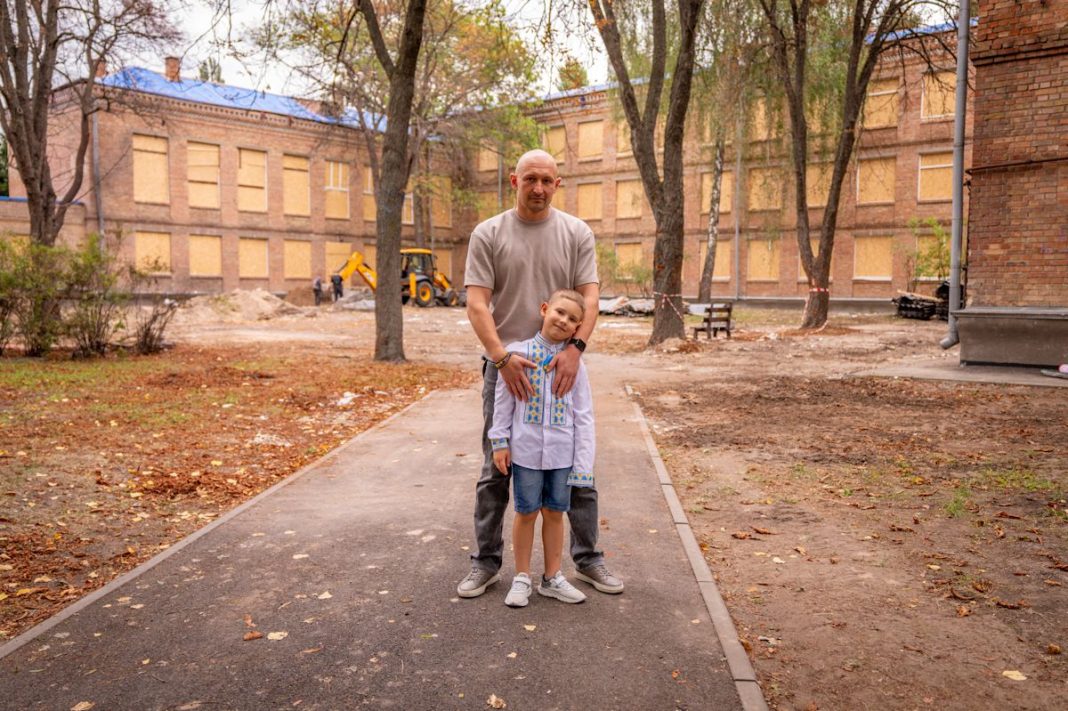
Yevhen Yurko brought his 6-year-old son Darii to the school on the boy’s first day. Darii had his first lesson online but he wanted to see the school in person.
Yurko photographed his son wearing a traditional embroidered vyshyvanka shirt in the nearly empty schoolyard.
“Even like this, I still wanted something to remember this day by,” Yurko said.
He and his wife plan to stay in Kyiv and keep Darii in the school. They believe he can learn there even if classes are held in a basement.
Since the start of the full-scale war, 318 education facilities in Kyiv have been damaged, including 156 schools, according to the city’s education department. Some schools have been hit two to eight times.
The number of first-graders in Kyiv schools has dropped by about 40% since the start of the war — from 28,500 on Sept. 1, 2022, to 16,600 this year.
“Ukrainian education right now feels like a constant obstacle course,” said Anna Putsova, a co-founder of the savED charitable foundation. “The system adapts, but conditions often change faster than you can build one model and say: ‘now we work like this.'”
Damage to education threatens Ukraine’s future
The war’s toll on education is “very serious,” Putsova said, citing accumulated learning loss, a shrinking student population and a heavy burden on schools and teachers. The number of schoolchildren in Ukraine has fallen 17.5%, or by more than 755,000, since the 2021-22 school year.
“School is an environment where a child learns to interact with others, build relationships, work in a group, resolve conflicts, be part of a community,” Putsova said. “For some Ukrainian children, there hasn’t been a normal school experience in several years.”
The war’s impact varies sharply by region, she said: some areas face constant air raid alerts, while others have relied mostly on online learning for years because safe in-person classes are only possible underground. Some communities have seen an influx of displaced children outpace school capacity, while others have lost so many students that schools have had to merge or close.
Among regions where savED works, damaged or destroyed schools account for more than 92% of those operating in the Ukraine-held part of southern Kherson region and about 39% in Mykolaiv. In the eastern Kharkiv region, the figure is more than 67%; in the northern Sumy region, nearly 54%.
“In the long term, this is no longer just a question of school,” Putsova said. “The knowledge level of today’s children will determine the quality of future specialists, the productivity of the economy, the country’s ability to create complex products and technologies.”