

By Mike Stone, Erin Banco and David Jeans
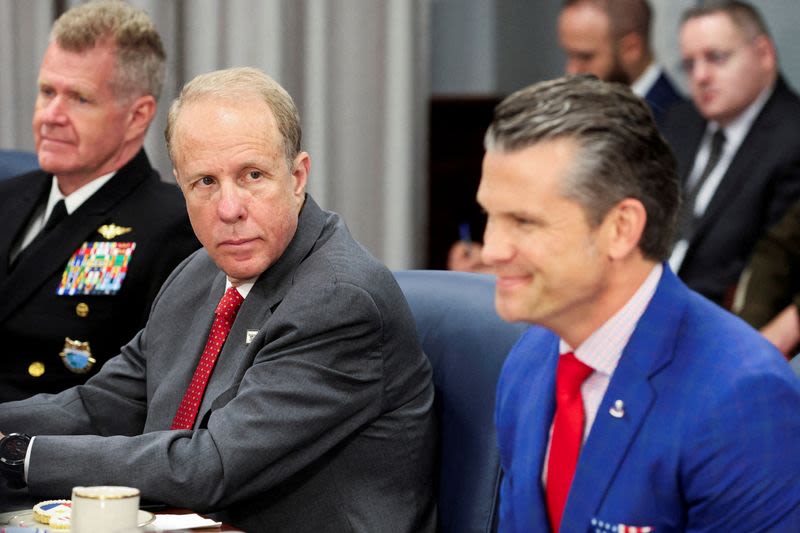
WASHINGTON/NEW YORK, Sept 4 (Reuters) – The White House has reviewed candidates to potentially replace Deputy Secretary of Defense Steve Feinberg, three people familiar with the discussions told Reuters, a sign that more leadership change could come for a Pentagon already facing unusually high staff turnover.
The effort, which was under way in June, has included conversations with senior lawmakers in the Senate about whether the administration’s picks would have enough support to be confirmed, said two of the people, one of whom added that the review was still going on as of late August. Reuters could not determine when the White House began considering candidates.
The three sources said no decision had been made to remove Feinberg from his post. They did not say why the White House was reviewing potential replacements and did not specify which candidates the White House was considering.
“These so-called anonymous ‘sources’ have no idea what they are talking about,” said White House spokeswoman Anna Kelly.
“President Trump appreciates the work of Secretary Hegseth, Deputy Secretary Feinberg, and the entire Department of War, whose record of success in Operation Epic Fury, Operation Absolute Resolve, and Operation Midnight Hammer speaks for itself,” she said, referring to U.S. military operations in Iran and Venezuela.
The Pentagon denied a process was under way to replace Feinberg. Asked for comment by Reuters, Hegseth said in a statement that Feinberg has his full support and “isn’t going anywhere.”
The Pentagon did not provide a comment from Feinberg and declined to make him available for an interview.
A departure by Feinberg, the billionaire co-founder of private equity firm Cerberus Capital Management, would be the most senior staff change for a department that has already seen a string of high-profile departures under Secretary of Defense Pete Hegseth.
Army Secretary Dan Driscoll resigned this week following months of tension with Hegseth, according to a source familiar with the matter. The Army has declined to comment on the reasons for his departure. Navy Secretary John Phelan and several senior Army leaders have also departed in recent months.
Feinberg, who vowed to accelerate U.S. munitions production, has not yet met that goal, according to analysts who say that the U.S. industrial base cannot ramp up quickly. Some defense industry executives say his task has been complicated by the slow pace of Congress appropriating funds despite immense pressure from the administration.
Feinberg “has worked tirelessly to rebuild our Defense Industrial Base and ensure our military has everything it needs to win, and I look forward to continuing to work with him,” Hegseth said in his statement to Reuters, adding, “He’s doing a tremendous job for President Trump, for the Department, and for our warfighters.”
FRUSTRATION OVER THE IRAN WAR
Trump has increasingly expressed frustration with the lack of progress in the six-month-old Iran war, which has settled into a costly standoff between the U.S. and Iran.
One of the costs has been a drawdown of U.S. weapons stockpiles. Reuters has reported that the U.S. military faces significant shortages of certain munitions, which have alarmed Congress and military leaders.
Trump has dismissed the concerns, saying the U.S. has “far more munitions than anyone in the world.”
But in an exchange with Trump at Camp David earlier this month, according to the Washington Post, Hegseth blamed Feinberg for letting stockpiles of long-range guided missiles and air-defense interceptors shrink.
The White House has called the report “fake news.” In a statement to Reuters, chief Pentagon spokesman Sean Parnell said: “Secretary Hegseth did not mislead anyone about our munitions posture, and he did not blame Deputy Secretary Feinberg.”
Appointed by Trump last year, Feinberg has attempted to reshape the Pentagon by ramping up the U.S. military’s direct investments in companies and delivering loans to military contractors through multiple offices inside the department, including the Office of Strategic Capital and the newly created Economic Defense Unit.
In an August 18 memo he sent to defense firms and seen by Reuters, Feinberg called on contractors to speed up production and provide more transparency around pricing. The Pentagon did not respond to a question about the memo.
Feinberg has also come under scrutiny on Capitol Hill, where Democratic U.S. Senator Elizabeth Warren has raised concerns about whether his former firm Cerberus could benefit from the Pentagon’s spending on its Golden Dome missile defense program.
“There are no conflicts of interest between Deputy Secretary of War Steve Feinberg and Cerberus,” said Parnell. “He has completely divested from Cerberus and has recused himself from any conversations or business relationships between the Executive Branch and Cerberus.”
Cerberus did not respond to a request for comment.
(Reporting by Mike Stone in Washington, Erin Banco in New York, and David Jeans in New York; Editing by Don Durfee, Joe Brock and Edmund Klamann)