
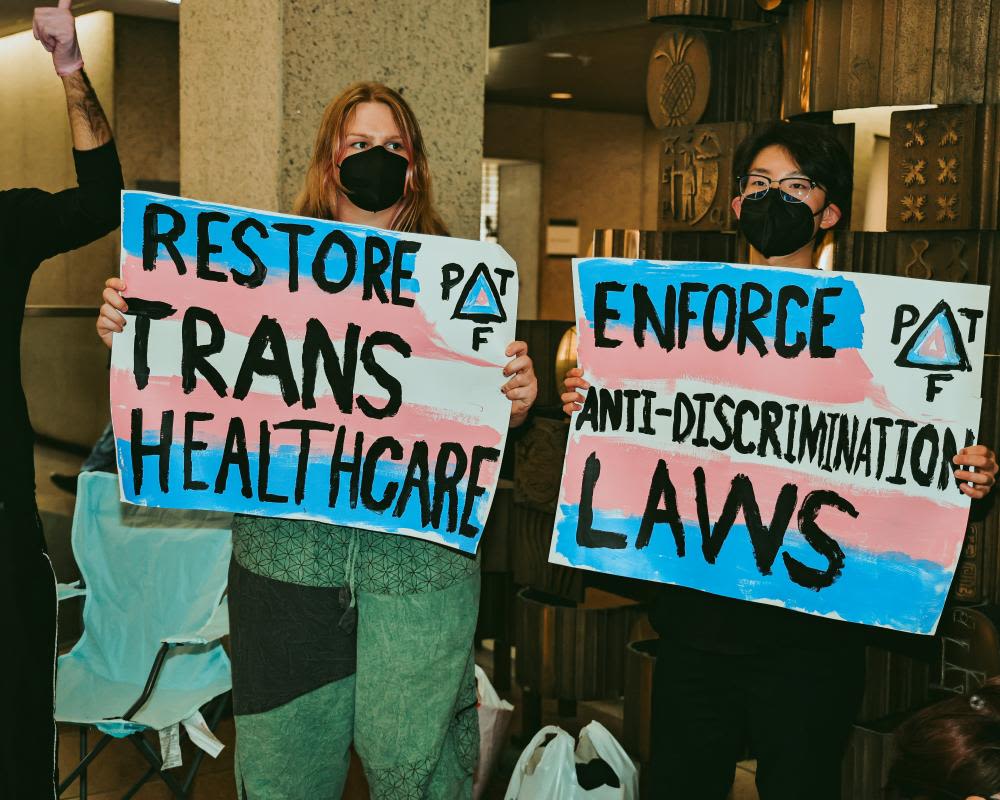

A group of trans activists from across Massachusetts brought their needles, hormone gels, pills and sharps containers to Boston on Wednesday to send a message to state attorney general Andrea Campbell.
Organizers with the youth-led group Protect Trans Futures (PTF) took their hormone replacement therapy (HRT) in the lobby of her office building, then occupied the space, refusing to leave without a commitment to protect civil rights for trans kids.
While Massachusetts is considered one of the legally “safest” places for trans people, some local hospitals are still dropping youth gender-affirming care and canceling surgery appointments amid an expansive legal fight across the US. Gender-affirming care remains legal for all in Massachusetts, but the Trump administration’s attempt to undermine state laws has still created barriers to care, and a chilling effect.
So organizers came asking Campbell to order those hospitals to reinstate care, or investigate or launch litigation against them for failing to do so.
Some advocates – who share Protect Trans Futures’ outrage at the hospitals for pre-emptively complying with Donald Trump’s agenda – fear undermining a sympathetic attorney general and eventually ending up with a less friendly replacement. But many trans organizers see the action as simply holding the government to its own standards.
“Massachusetts politicians at the local, state and federal level are very naive in thinking and hoping that there’s not this massive loss of care, but that’s not the reality of patients and families,” said Teddy Walker, a 21-year-old with Protect Trans Futures. “The Trump administration’s policies are working exactly as intended.”
A majority of American medical experts support access to trans youth care, which demonstrably reduces suicide and mental health risks. Nonetheless, in 27 states, such as Texas and Missouri, youth gender-affirming care is now restricted or banned; in some, doctors can be prosecuted for providing it, and parents have been investigated for seeking it out for their children. Fifty percent of trans youth ages 13 to 17 live in one of those states. Even hospitals in blue states, like New York’s NYU Langone, which ended care last year, have been subpoenaed for the medical records of their former minor clients.
After the state attorney general’s building had closed for the day, organizers were handed a phone: An assistant attorney general offered them a meeting – a step organizers had taken months before, with no results.
So they refused.
After a few hours, nine organizers, including Walker, were arrested by state troopers. (The attorney general’s office told the Guardian they were not involved in the decision to arrest the protesters.)
He screamed a message to supporters witnessing his arrest – a chant from LGBTQ+ activists who held die-ins and other protests to force a change in the Aids epidemic: “Act up! Fight back!”
The ‘trans great migration’
Over the last few years, hundreds of thousands of trans people and families with trans kids have fled home states with anti-trans laws, relocating to states like Massachusetts in hopes of maintaining access to gender-affirming care and other trans civil rights.
Massachusetts is one of a handful of US states with shield laws to protect LGBTQ+ residents from lawsuits and penalties from states where gender affirming care is criminalized. In addition, elected officials in the state are vocal supporters of their trans constituents, including Gov Maura Healey, the state’s first woman and lesbian governor, and Senator Edward Markey, who won the Democratic primary this week in a race that was largely defined by trans rights.
But the Trump administration attacked these state-level protections for trans youth healthcare soon after taking office in January 2025. In the first weeks of his second term, the president signed an executive order threatening to cut off federal funding for hospitals that provide gender-affirming medical care to trans youth. Later that year, health secretary Robert F Kennedy Jr sought to target Medicaid funding to hospitals providing youth gender affirming care. Many of those efforts have been tossed; there are no reports of hospitals losing federal funding for providing this care.
Still, in response to the administration’s directives, at least three local hospitals or healthcare systems in Massachusetts have ended gender-affirming care programs for patients under 19. (This means that 18-year-olds, who are legally adults, are impacted.) A fourth Massachusetts hospital canceled all appointments for a gender-affirming surgery for adult trans women, even though adults aren’t the subject of Trump’s executive order.
Initially, organizers protested outside these hospitals in an effort to pressure them to reinstate the care. They later shifted their focus to pressuring state officials to enforce existing civil rights laws.
In April, Campbell’s office met with a group of trans youth advocates after some hospitals ended care for youth. She has repeatedly expressed support for trans youth, saying that trans healthcare “remains legal and protected” in Massachusetts, and warning hospitals that ending youth gender-affirming care “may amount to discrimination” under state law. And on 2 September, the same day as the protest at her office, Campbell joined 21 other state attorneys general in suing the Trump administration over its attempt to block Medicaid coverage for youth gender affirming care.
In August, Walker publicly confronted Campbell at an event at the Boston public library over her inaction. She stated she will not litigate against hospitals that have ended care, and has not ordered them to reinstate it, as attorneys general in blue states like New York and California, as well as Colorado’s supreme court, have done.
After Wednesday’s protest, the attorney general’s office shared with the Guardian the email it sent to Protect Trans Futures. In it, the attorney general’s office argued that what’s been done in California and New York were imperfect comparisons and would not result in care being reinstated in Massachusetts. The office reiterated that youth gender affirming care remains legal in the state, and wrote, “The cessation of gender-affirming care for minors by Fenway Health, Outer Cape Health Services and Baystate Health has not resulted in a wave of hospitals or clinics ceasing to provide care in the Commonwealth.”
The email added, “The AGO and PTF share a common goal: maintaining access to gender-affirming care.”
Campbell’s office has said it is unaware of any youth who has lost care, but Walker, of the group Protect Trans Futures, says he knows dozens of youth and their families who have. In its email, the attorney general’s office asked PTF to connect with those families. Walker said that the group has previously brought those families to meetings with the office, but nothing came of it.
Shattered trust
Last October, Fenway Health, Massachusetts’ largest LGBTQ+ healthcare provider, stopped providing youth hormone care and puberty blockers, routine medical care to prevent the major physical changes that come during puberty. Fenway was a particular blow: from its founding as a community health drop-in location in the early 1970s, it centered gay clients and made the first Aids diagnosis in New England. Other providers, including Outer Cape Health Services, which runs three facilities on Cape Cod, and Baystate Health, which services western Massachusetts, followed suit.
Other hospitals and clinics have taken in those who’ve lost care. Transhealth in Northampton, the country’s only independent clinic focused solely on trans and gender-nonconforming patients, has shouldered an avalanche of referrals.
Josh, who asked to use a pseudonym for privacy reasons, 18, was born at Fenway to lesbian parents, and still sees his primary care physician there. Following the typical medical routine for youth who transition in childhood, he started going to Fenway for hormone replacement therapy in middle school.
After two years on puberty blockers, he then started taking testosterone. That process is intentionally slow, requiring letters from therapists and evaluations, often taking at least a year. When Fenway halted care last year, Josh was able to get a referral to Boston Children’s hospital, which has vocally refused to close its trans healthcare program. Restarting the intake process, however, took over a year, he said. It shattered his trust that his home state would be able to protect him.
He’s just one case of young people abruptly stripped of care.
Safara Malone, a senior at Harvard University, moved to Massachusetts from Texas, which has extreme anti-trans laws, in 2024. Malone was a strident advocate for trans rights in her home state and intentionally chose a college where she would face fewer barriers and find more explicit support. But with graduation less than a year away, Malone says she’s not sure where she’ll feel safe living next, amid what she called the trans “great migration”. It was difficult for her to realize that had she arrived in Boston just one year later – after the changes at Fenway – she would have been refused her care.
Malone is now considering leaving the country.
Fighting for change
Now, trans people of all ages are fighting to protect the very civil rights that brought many of them to Massachusetts in the first place.
Fenway’s cessation of care spurred the creation of Protect Trans Futures, a group of trans youth that has been fighting the state government and hospitals themselves to reinstate care. PTF has held a series of actions this summer pushing Campbell to consider their demands, including coordinating a letter campaign which now has more than 3,000 signatures.
After Baystate cut off youth gender affirming care, another group, Western Massachusetts Trans Alliance (WMTA), emerged to push back. These nascent grassroots efforts join the existing fabric of LGBTQ+ and trans advocacy organizations across the state, including the Massachusetts Transgender Political Coalition. Other organizations like the Boston chapter of the Democratic Socialists of America have signed on to PTF’s efforts.
Many of these groups, as well as the national Gender Liberation Movement, joined PTF outside Campbell’s offices. A grassroots group of parents and other adults from western Massachusetts also came in to support and set up a large banner depicting a blue bus labeled “Baystate Health”. Around the banner, people held smaller signs that read “throws trans kids under the bus”. Under the banner, fabric legs with children’s sneakers poked out.
“Unlike Boston, western Mass does not have as many choices for healthcare,” Ali Wicks-Lim, one of the grassroots organizers protesting Baystate, said outside the attorney general’s office Wednesday. “So for them to end this gender-affirming care means that people have to travel further, and search harder, to find any kind of gender affirming care for their youth.”
Wicks-Lim says that they’ve heard of many families who have not been able to find another provider.
“Once we let the government start making decisions about what we do with our bodies, and what our children are able to do with our bodies, and the decisions that parents and grandparents and caregivers need to be able to make for their children”, they said, “we’re in a really dangerous territory.”