
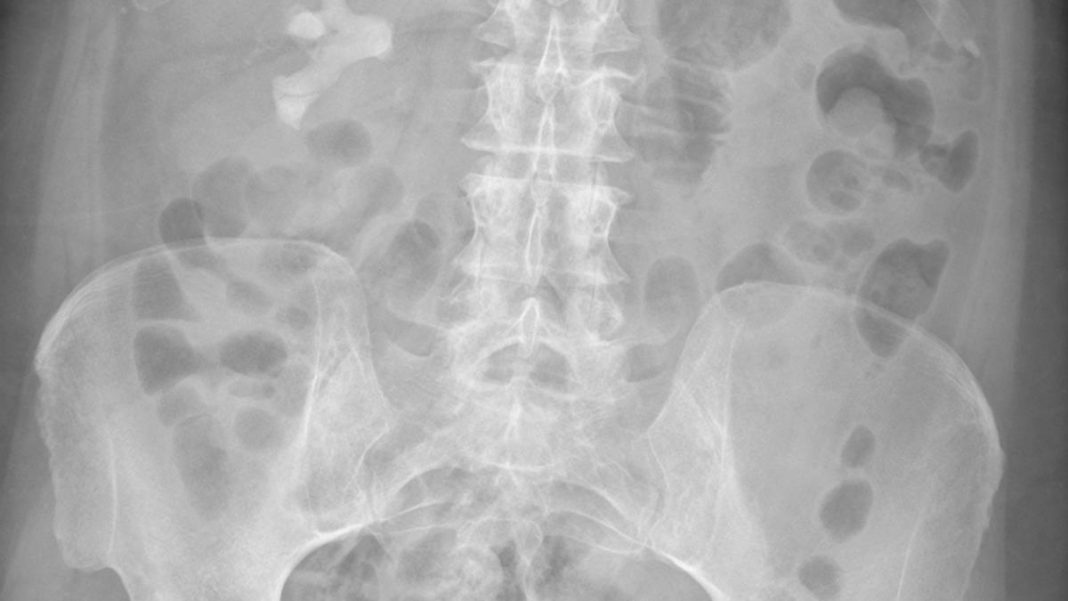

I’ve always thought of human bodies a lot like complex machines. Once you get to the root of a problem, there are likely several others awaiting you. That was certainly the case for Chrissi Anderson of Omaha, Nebraska, who told TODAY.com that she got the surprise of her life when she went to the CHI Health Creighton University Medical Center for an emergency appendectomy.
The pain began for Chrissi in her “lower flank,” and she knew she had to get to a hospital quickly. Doctors swiftly determined her appendix was about to burst, but when they did a CT scan to confirm their diagnosis, they saw something they very much weren’t expecting. Doctors saw a 1-pound kidney stone with antlers just sitting there.
“I couldn’t believe it. It was huge and it had horns, and it was like a monster,” Anderson told the outlet. “And they’re like, that’s what’s growing inside your kidney. It was just massive.”
Related: The Best Carb for Aging and Gut Health, According to Dietitians
What Was Anderson’s Diagnosis?
Anderson had never had any kidney stones before and didn’t have any noticeable symptoms typically associated with stones.
Dr. Euclid de Souza, her urologist, told TODAY.com that that was actually typical for the type of kidney stone Anderson had: a staghorn kidney stone.
“The problem with staghorns is they’re very silent because they are big and they cannot move, whereas people complain about the small stones because they move,” de Souza explained. “The smaller the stone, usually more the pain, because they can move around, block the kidney, so the urine has nowhere to go. Whereas these stones have found a home for themselves in the kidney, and they don’t move around, so urine drains around them.”
Anderson was pretty lucky her appendix flared up when it did. If that stone had gone undetected, it could have damaged her kidney, and she could have lost the organ altogether. While you can live without one kidney, it’s ideal to hang on to both of them for a myriad of reasons.
Her doctor believes it had secretly grown for years, as most stones he removes are typically only five millimeters in size. Stones develop from frequent urinary tract infections. According to a Sultan Qaboos University study, around 50–60% of women will develop UTIs in their lifetimes, and recurrent ones are caused by reinfection by the same pathogen. There are several factors that can contribute to recurrent UTIs; it could simply be one’s anatomy (i.e., a shorter urethra in females), frequent sexual activity, or even incomplete bladder emptying.
The “head of the deer” on Anderson’s stone measured about 3 inches across with another 3 inches for the “antlers,” according to de Souza. It was so large, in fact, it had to be removed in four parts.
“We had a stone crusher that we were able to use to break up where the big part was connected to the finger-like projections,” he says.
Related: Bijou Phillips Says She’s ‘Hanging on by a Thread’ as She Waits for Kidney Transplant
What Anderson Can Expect Going Forward
Now Anderson is recovering well and says the uncomfortable pressure she felt in her back and legs, which she previously attributed to fibromyalgia, is gone.
Of course, Anderson, and really anyone whose had kidney stones, is at risk of forming stones again.
Some preventative measures women can take to avoid UTIs are:
The 30-Minute Rule: Urinate as soon as possible (ideally within 30 minutes) after sexual activity.
Hydrate: Drinking plenty of water is the top defense to help you urinate frequently.
Don’t “Hover” or “Hold”: When you have to go, go. Holding in urine allows bacteria to multiply. Also, try to sit fully on the toilet seat rather than hovering; relaxing the pelvic floor muscles ensures the bladder empties completely.
Skip Products: You actually don’t need douches and sprays; your vagina is naturally self-cleaning.
This story was originally published by Parade on Mar 27, 2026, where it first appeared in the News section. Add Parade as a Preferred Source by clicking here.