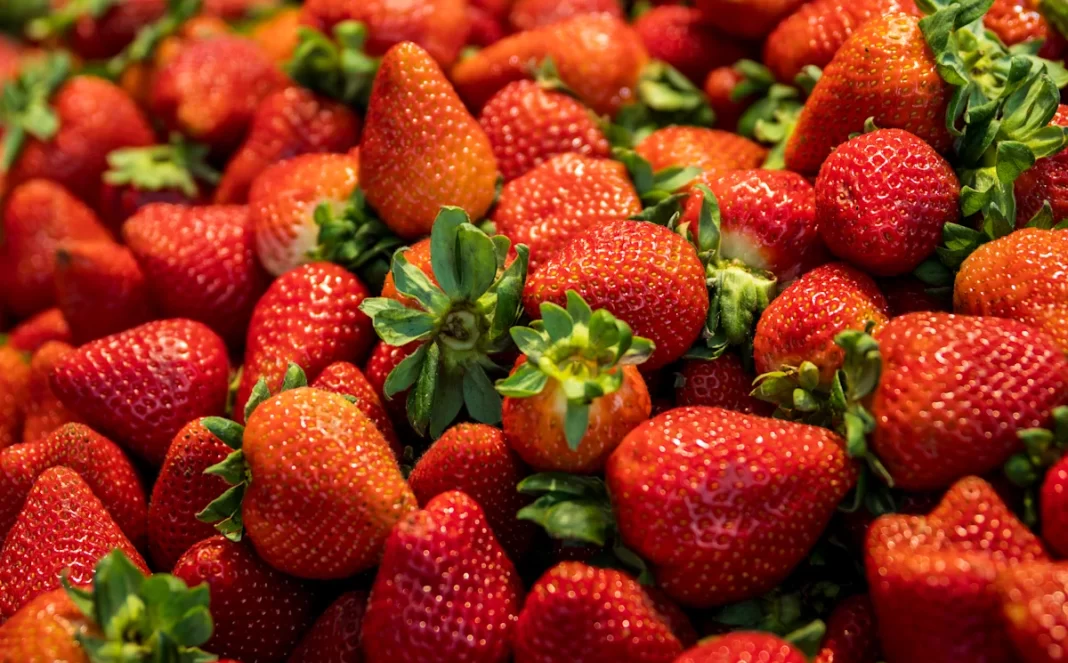

I’ve written a lot about Driscoll’s this year — the pesticide residue findings, the organic alternatives, the PFAS conversation, the EWG Dirty Dozen context. But The New York Times just published a piece that zooms out significantly further, and the picture it paints of the company behind your clamshell of strawberries is worth understanding alongside all of that.
The number that puts everything in context
Driscoll’s is a $7 billion company. That figure alone reframes the conversation. Driscoll’s commands approximately one-third of the multi-billion-dollar United States berry market, and according to the Times piece, the brand is now the second-highest-earning in American supermarkets — behind only Coca-Cola. Berry consumption has surpassed $10 billion as a retail category, nearly double the second-largest produce category, grapes, making berries the fastest-growing category in American produce.
The 1989 decision that made it all possible
The reason you can buy strawberries, raspberries, blueberries, and blackberries year-round — in the middle of winter, in the middle of the country, with no seasonal disruption — traces back to a single corporate resolution. In 1989, Driscoll’s board made what the company calls the Meadowood Declaration: a commitment to make all four berries available in every season, in every part of the world. At the time, the Times reports, it seemed preposterous. It turned out to be the blueprint for a company that now grows berries in 21 countries and sells them in 48.
How they actually do it
Driscoll’s operates not merely as a farming cooperative but as a highly sophisticated genetics and data corporation. The company has a staff of 30 scientists devoted solely to strawberries, manipulating evolution at nine research stations across California, Florida, Spain, Mexico, and the UK. The goal of all that genetic work is not flavor first; it’s durability, uniformity, and shelf life for global transport. Berries are rapidly cooled within an hour of being picked to arrest the ripening process, then tracked via sophisticated sensor arrays through the entire global transit matrix to ensure temperature never deviates from a precise parameter.
The Times piece includes a detail worth sitting with: a pound of strawberries costs $3 in San Francisco and $35 in Dubai. That price differential is a window into how comprehensively Driscoll’s has engineered global berry availabilitym and what that engineering actually costs at the premium end.
The premium tier
Eight years ago, the super-premium berry segment was a “nothing business,” but the industrywide super-premium category grew to nearly $700 million last year, with Driscoll’s accounting for roughly $400 million of that total. Driscoll’s Sweetest Batch line — which commands roughly 30% more than standard berries — is the result of a breeding program that studies 125,000 strawberry varieties a year to find the rare genetics that prioritize flavor. The tradeoff is yield: higher sugar content means lower biomass, meaning the most flavorful berries are inherently less productive to grow.
The clamshell
One of the more charming details in the Times piece: Driscoll’s invented the hinged, ventilated plastic clamshell packaging that now holds virtually every container of fresh berries in the American supermarket. That happened in the 1990s and was, at the time, a genuine packaging innovation designed to reduce bruising during transport. The clamshell is now so universal it’s invisible. That’s a pretty good summary of how thoroughly Driscoll’s has shaped the berry experience without most consumers having any idea.
The full picture
None of this makes the pesticide conversation less relevant. It makes it more layered. Driscoll’s is not a small company trying to get by. It is a genetics and logistics operation of extraordinary sophistication that has engineered year-round global berry availability as its core product. The pesticide findings, the PFAS detections, the questions about conventional vs. organic — all of that lands differently when you understand the scale and the model behind the clamshell you’re holding at the grocery store.
TL;DR:
The New York Times just published a comprehensive look at Driscoll’s — the $7 billion company that controls roughly a third of the US berry market and is the second-highest-earning brand in American supermarkets behind Coca-Cola. The 1989 Meadowood Declaration committed the company to year-round global availability of all four berries, which seemed impossible at the time. Driscoll’s is now a genetics and cold-chain logistics company as much as a berry company, growing in 21 countries and selling in 48. The pesticide conversation I’ve been covering looks significantly different when you understand what’s behind the clamshell.