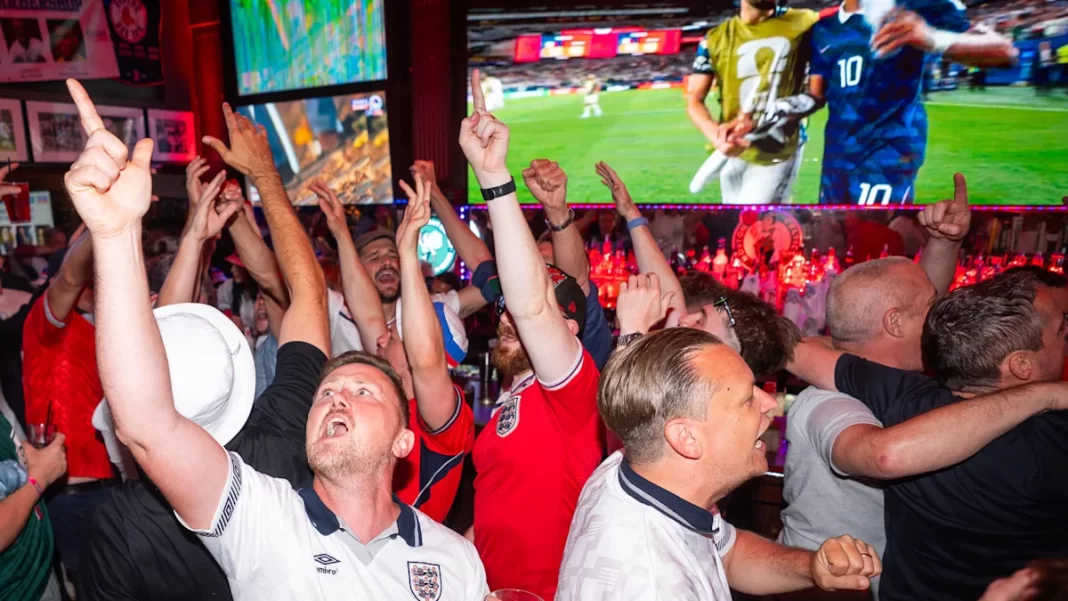

Millions of World Cup fans from overseas have spent the first two weeks of the tournament indulging in the endless pleasures of American food and drink.
But tipping afterwards? That’s still getting lost in translation — and restaurants across America’s 11 host cities are struggling to respond.
“We depend on [tips], but unfortunately we cannot depend on them, because of how low they are,” New York City bartender Jessica Ordeñana told Axios after a large party racked up a bill of about $300 during Tuesday’s match between Argentina and Algeria. “They left like a $4 tip, and that was really, really disgusting.”
Any American who has traveled abroad knows how confusing foreign tipping culture can be. In the U.S., many servers and bartenders — who can earn as little as $2.13 per hour — rely heavily on gratuities to make a living wage. That’s why customers almost always leave an extra 15% to 20% tip when settling up. But in Europe and elsewhere, service is included in the price of the meal, and your waiter is paid just like any other worker. So you can leave a euro or two for exceptional treatment — or not.
Some visiting fans, it seems, have yet to adjust. “Everyone has been really sweet . . . they’re loud and happy, very nice,” waitress Louise Daggett of McCarthy’s Pub NYC told the New York Post. But “a lot of people haven’t been leaving tips” — even when they’ve “had a tab of almost $700.”
Daggett insisted that no one was trying to be rude. “They do ask,” she told the Post. “They say, ‘Oh, how do I do this?” I explain to them that tipping is big here in the city, and it’s a nice habit to do.”
To protect their tipped staff during the World Cup, some bars and restaurants have tried adding an automatic 18% to 20% gratuity to all checks — with mixed results. At Ordeñana’s bar, the “auto grat” is only for tourists — but it “occasionally gets missed during busy game days,” Axios reported. Meanwhile, in Kansas City — where the Missouri restaurant association initially recommended the automatic gratuities — several establishments are now reversing course after the World Cup bump they anticipated failed to materialize.
“People are avoiding downtown because they think it’s going to be crazy, but it’s not,” the owner of a Thai noodle shop told the Kansas City Star.
“Also some people got upset with the automatic gratuity,” added the proprietor of a nearby pizzeria.
All of the back and forth is “sparking a very important debate,” according to independent journalist Aaron Parnas. After the Civil War, American restaurants adopted tipping — originally a feudal European invention — because they “wanted to be able to continue to access free Black labor,” Saru Jayaraman, president of advocacy group One Fair Wage, told Axios. “So they mutated tipping from being an extra bonus on top of the wages… to becoming a replacement for wages.”
Now the practice is, of course, entrenched. But it’s not handled the same way in every corner of the country. In states such as California, Minnesota and Montana, servers receive tips on top of the regular minimum wage rather than the reduced federal minimum for tipped workers — and research shows the poverty rate for these workers is “dramatically lower” than it is for their tipped counterparts elsewhere.
So “instead of tipping culture, how about restaurants just pay their servers and employees a fair wage?” Parnas asked on social media.