
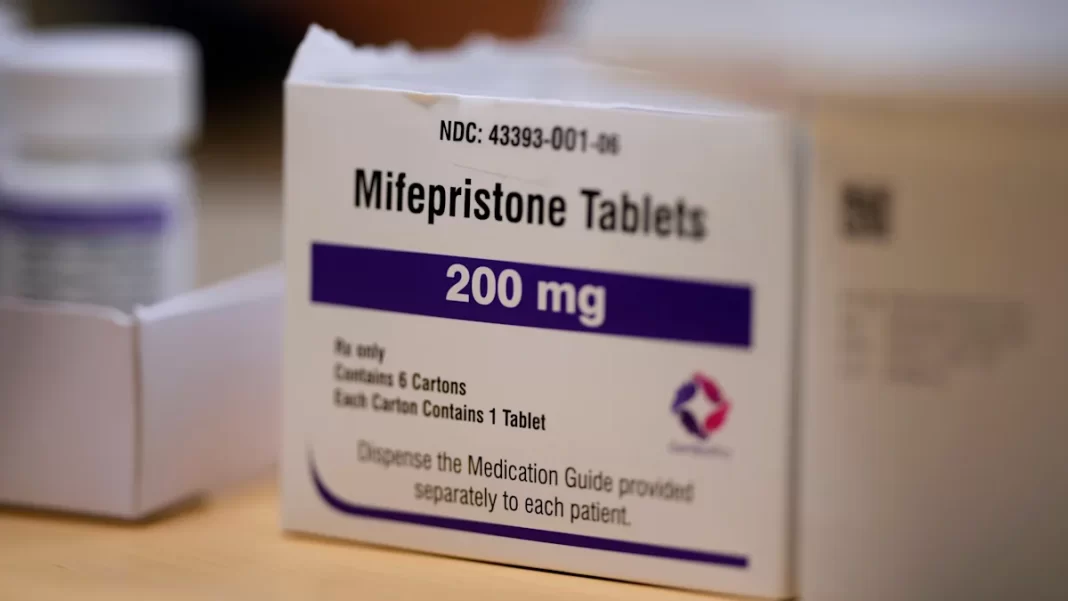

The Supreme Court on Monday temporarily restored nationwide access to mifepristone, an abortion pill that can be prescribed by telemedicine and mailed to patients across state lines.
The one-sentence order, issued by Justice Samuel Alito, a conservative, pauses a lower-court ruling that would have prevented abortion providers from sending mifepristone through the mail until at least May 11.
Mifepristone has been a major abortion flashpoint ever since the Supreme Court overturned Roe v. Wade in June 2022, instantly dismantling nearly 50 years of nationwide legal protection for the procedure. After that decision, most Republican-led states moved to ban or sharply restrict abortion — and as clinics in those states closed, more patients resorted to telemedicine to access mifepristone. Meanwhile, some Democratic-led states passed shield laws to protect abortion providers who continued to send pills to patients in states with abortion bans.
As a result, nearly two-thirds of abortions in the U.S. are now induced by medication, and about one quarter involve telemedicine. To end a pregnancy, health care providers prescribe two artificial hormone pills, mifepristone and misoprostol. Mifepristone blocks progesterone, the hormone needed to support a pregnancy, while misoprostol causes cramping and bleeding, and empties the uterus, according to Cleveland Clinic. Their use has long been approved by the Food and Drug Administration as safe and effective for medical abortions during the first 10 weeks of pregnancy. They’re also sometimes used to manage miscarriages.
The current Supreme Court case was brought by the state of Louisiana, which sued the FDA to block access to mifepristone by mail. Years ago, the FDA required patients to obtain the pill in person — but that rule was lifted in 2021, during the COVID-19 pandemic.
Abortion opponents argue that sending mifepristone across state lines poses safety risks to patients and raises health care costs for states that have banned the procedure. But major medical organizations have pointed out that the pill has already been extensively investigated for safety.
By the same token, as the New York Times reported in 2021, reproductive health experts have long insisted that “there are no significant safety reasons for in-person dispensing of a pill that women are then legally allowed to take on their own in any location, and that the restriction places the greatest burden on low-income women and those in areas with limited access to abortion providers.”
On Friday, the conservative U.S. Court of Appeals for the Fifth Circuit ruled that the FDA’s old mifepristone rule — the one requiring patients to obtain the pill in person — must be reinstated. But two mifepristone manufacturers appealed to the Supreme Court the following day, and Alito, the justice assigned to handle emergency applications from the Fifth Circuit, issued a temporary stay that will allow patients to continue to access mifepristone by mail for at least the next week.
The stay was not unexpected, and it does not offer any clues on how the court will eventually rule. Alito asked both parties to file briefs by Thursday, at which point he and the other justices will decide how to proceed.
The lower court’s ruling came after the Trump administration had asked it to put the litigation on hold while the FDA conducts its own review of mifepristone. That review began in late 2025 under Health and Human Services Secretary Robert F. Kennedy Jr. The American Civil Liberties Union has called the administration’s review a “thinly veiled attempt to lay the groundwork for additional medically unjustified restrictions” on the drug.
During the 2024 presidential campaign, President Trump made a point of saying he wouldn’t block the abortion pill mifepristone if reelected.
In a similar 2024 case brought by anti-abortion physicians, the Supreme Court upheld full access to mifepristone, arguing that the doctors did not have legal grounds to sue.
Justice Brett Kavanaugh, who was appointed by Trump, wrote the opinion. “Under Article III of the Constitution, a plaintiff’s desire to make a drug less available for others does not establish standing to sue,” Kavanaugh explained, adding that “federal courts are the wrong forum for addressing the plaintiffs’ concerns about [the] FDA’s actions.”