
Sunday, May 31, 2026
16 C
London

After Blue Origin rocket explosion, NASA’s entire moon exploration program depends on SpaceX for now as Musk eyes blockbuster IPO soon


With a record-setting IPO in just a few weeks, SpaceX saw its rival in a contest to put astronauts on the lunar surface go up in flames, reinforcing its dominance in the space race and its primacy in NASA’s plans to go back to the moon.

On Thursday, a New Glenn rocket belonging to Jeff Bezos’ Blue Origin exploded during an engine-firing test at the launch pad in Cape Canaveral, ahead of a satellite launch scheduled for next week.

Blue Origin also planned to use the rocket to launch landers to the moon for NASA, delivering payloads and astronauts to the surface. SpaceX is jockeying to be selected by NASA for the lunar mission too, and may emerge as the only remaining option to meet an ambitious schedule.

The vulnerability highlights the multiple steps—and contractors—a lunar landing would entail. While NASA successfully sent astronauts around the moon last month in a Lockheed Martin Orion capsule launched by Boeing’s massive Space Launch System rocket, landing on the moon’s surface requires a separate spacecraft.

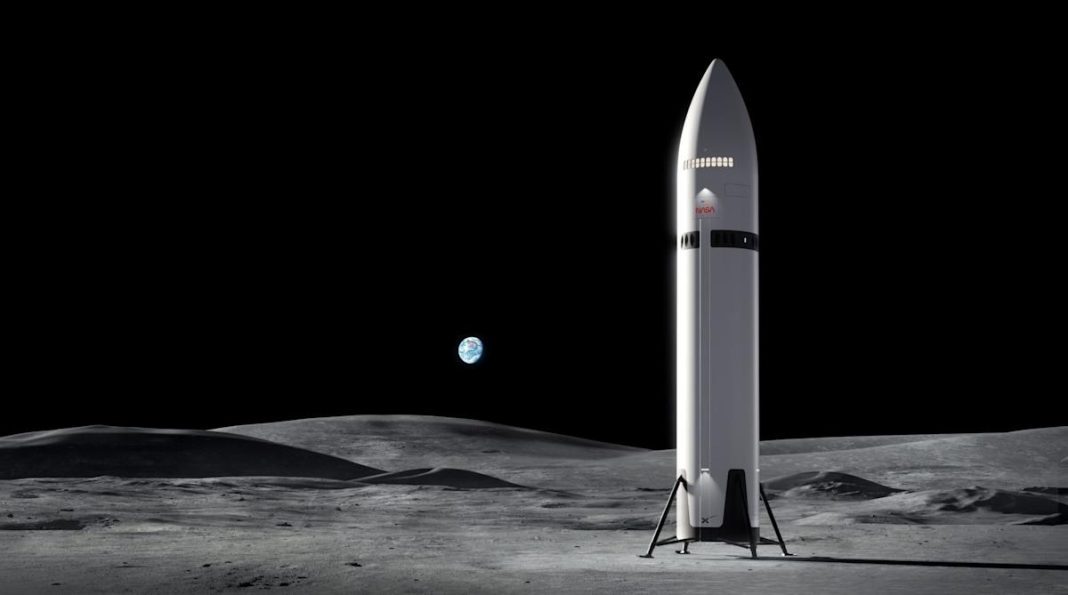
Next year, NASA plans to send astronauts into Earth orbit via the Orion and Space Launch System as part of its Artemis III mission. While in orbit, NASA expected to dock the Orion with either SpaceX’s lunar lander, a variant of the Starship, and/or Blue Origin’s lander, the Blue Moon.

But the New Glenn is supposed to launch the Blue Moon into space, and the rocket is now grounded as the cause of the explosion is investigated. Just days before the explosion, NASA awarded Blue Origin launch contracts, including one this fall for a Blue Moon lander mission to put NASA payloads on the surface.

A Blue Origin New Glenn rocket explodes during an engine-firing test on Thursday, May 28, 2026, in Cape Canaveral, Fla.

“Blue Origin’s inability to launch Blue Moon anytime soon is likely to put the company out of the running for Artemis III,” wrote Wendy Whitman Cobb, a professor at the U.S. Air Force School of Advanced Air and Space Studies, in the Conversation on Friday. “This setback means that Artemis III, and NASA’s entire lunar exploration program, is likely to be dependent on SpaceX for the time being.”

Meanwhile, SpaceX is still developing the Starship. While a next-generation version of the giant rocket completed a test flight this month that was largely successful, more work needs to be done to produce a lunar-lander variant.

Whitman Cobb warned that if SpaceX can’t get Starship ready in time, then NASA may need to delay the Artemis III orbital-docking test by a year to 2028—meaning the Artemis IV mission to put astronauts on the moon will miss its 2028 timeline.

Further delays could also open the door again to Blue Origin, if it can get the New Glenn back on track soon and test out its lunar lander.


But a mishap highlighting NASA’s reliance on SpaceX could not come at a better time for CEO Elon Musk, whose company is expected to go public on June 12 in what will likely be the largest IPO ever. SpaceX is seeking to raise up to $75 billion at a valuation of $1.75 trillion or more.

Since its founding in 2002, SpaceX has taken over the market. It claimed more than 80% of global rocket launches last year and has over 10,000 Starlink satellites in orbit, providing space-based internet connections to businesses and militaries.

In addition to serving NASA, SpaceX is a top launch provider for the Pentagon, which is also looking to the company to help develop President Donald Trump’s “Golden Dome” missile-defense shield.

“It’s a truly unique business with the deepest moat that exists today,” an investor told the Financial Times recently.

Starlink is SpaceX’s cash cow as the satellite business more than doubled its profit last year to $4.4 billion. Blue Origin has plans to compete in that arena as well by building out its constellation of Leo satellites. But the New Glenn explosion, which also damaged Blue Origin’s launchpad, has set that back as well.

Walter Isaacson, an author and an advisory partner at Perella Weinberg, pointed out that the New Glenn accident not only puts Blue Origin behind SpaceX in the lunar mission but further behind its rival in the satellite business.

“SpaceX is way ahead, and the loss of this launchpad on during this test means that it’s going to be harder for Blue Origin to catch up in the next two or three years with low-Earth-orbit communication satellites,” he told CNBC on Friday.

This story was originally featured on Fortune.com


.

Hot this week

Albuquerque police ID man killed by officers

The Albuquerque Police Department said two officers surrounded a...

Flathead County Compensation Board recommend increase in county attorney’s salary

After three rounds of votes, the Flathead County Compensation...

Moulton to take on incumbent Markey in Massachusetts Democratic Senate primary

U.S. Rep. Seth Moulton, a moderate Massachusetts Democrat, secured...

White House denies NYT report alleging Wiles urged Vance to take social media break

The White House on Saturday denied a report by...

Topics

Albuquerque police ID man killed by officers

The Albuquerque Police Department said two officers surrounded a...

Flathead County Compensation Board recommend increase in county attorney’s salary

After three rounds of votes, the Flathead County Compensation...

Moulton to take on incumbent Markey in Massachusetts Democratic Senate primary

U.S. Rep. Seth Moulton, a moderate Massachusetts Democrat, secured...

Did you hear it? Residents throughout New England report loud explosion

A loud explosion was heard throughout New England on...

Trump criticizes the judge who ordered his name removed from the Kennedy Center

President Trump attacked the federal judge who blocked his...
spot_img

Related Articles

Popular Categories

spot_imgspot_img