
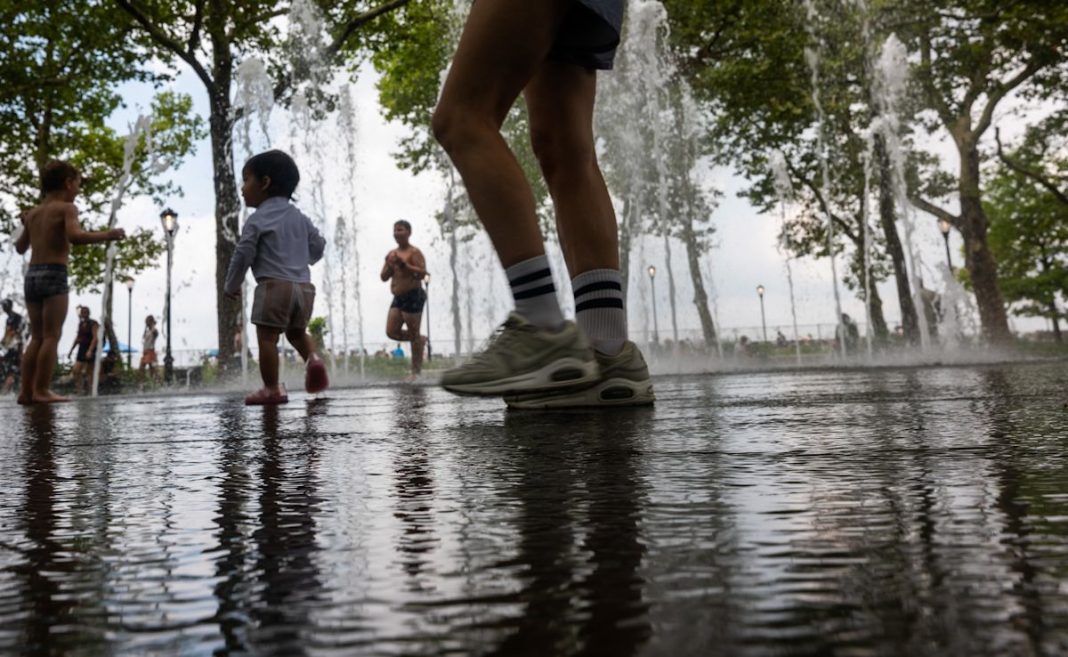

The stretch of humidity that made the East Coast feel tropical this week is ending. Heat advisories for New York City, Boston and much of the corridor between them expire Saturday, and forecasters expect the Northeast to turn into one of the more comfortable places in the country next week.
It was a remarkable run: About 80 million people were under extreme humidity this week, with very high humidity reaching 140 million more, the Washington Post reported. Washington had its muggiest start to August since at least 2002, logging 29 hours of dew points at or above 75 degrees in the first week alone, roughly four times normal.
The culprit was the Bermuda high, a dome of high pressure parked off the Southeast coast. Air circulates clockwise around it, which pulled tropical moisture out of the Caribbean and drove it north.
Know before you go outside. The new Yahoo Weather app tracks real-time heat and “feels like” temps for your area.
Where the heat goes next
The National Weather Service’s Climate Prediction Center has flagged a moderate risk of extreme heat for the Southern Plains, Lower Mississippi Valley and Southeast from Aug. 15 to 17, with a broader risk running through Aug. 21. Forecasters expect heat index readings of 105 to 110 degrees in that zone.
Closer in, mid-Missouri is looking at a heat index near 105 from Sunday through Tuesday.
Forecasters expect overnight lows to approach or break daily records, leaving little relief after dark. Heat becomes far more dangerous when the body cannot recover overnight.
The agency has also designated a rapid onset drought risk across parts of Oklahoma, northeastern Texas and northern Mississippi. Those areas are running 30-day rainfall deficits of more than 2 inches with little rain in the forecast, and the incoming heat will pull moisture out of the soil faster.

Cattle rest near the edge of a pond with wind turbines in the background amid a drought in Foard County, Texas, April 25, 2026. (AP Photo/Jon Shapley, File)
(AP Photo/Jon Shapley)The Midwest’s homegrown humidity

An ear of corn is visible before harvesting, Tuesday, Oct. 10, 2023, at a farm near Allerton, Ill. (AP Photo/Joshua A. Bickel)
(ASSOCIATED PRESS)The Midwest gets its mugginess from the Gulf, same as everyone else. But it also gets a contribution from the crops.
Corn pulls water from the soil and releases it through its leaves, the same way sweating cools a person. One acre of corn releases 3,000 to 5,000 gallons a day at peak growth. Illinois plants roughly 11 million acres.
“That contribution to humidity from transpiration or from those plants is really important for making the humidity worse,” Trent Ford, the Illinois state climatologist, told Fox 32 Chicago.
The effect showed up in the numbers during the last week of July. Burlington, Iowa, recorded a dew point of 85 degrees against a high of 92, producing a heat index of 121, according to a state agriculture report. Across the Mississippi in Belleville, Illinois, readings ran nearly as high.
“That is a mind-blowing number for me because I have never seen a dew point that high in Illinois,” Alan Black, a Southern Illinois University Edwardsville weather researcher, told the Edwardsville Intelligencer.
Not everyone credits the corn: Chad Lee, a University of Kentucky agronomist, ran the numbers and found the crop’s contribution is dwarfed by what is already overhead. A cornfield gives up roughly 4,000 to 8,000 gallons per acre on a peak day, he calculated, while the air above that same acre holds about 160,000 gallons.
“Corn is not making your days more humid unless you are walking in corn fields all day,” Lee wrote in June 2025.
Hot and dry out West
The West is under the same heat with none of the moisture. The Bay Area is under a heat advisory through the weekend with humidity between 15 and 30 percent, a combination that raises fire risk. Southern California’s deserts are under an extreme heat warning, and parts of Idaho are dealing with heat and wildfire smoke together.
Humid air keeps sweat from evaporating, so the body loses its main cooling method. Dry air evaporates sweat so quickly that people dehydrate without noticing.
Health officials recommend limiting outdoor activity during the hottest hours, drinking water before feeling thirsty and checking on older neighbors and anyone without air conditioning.