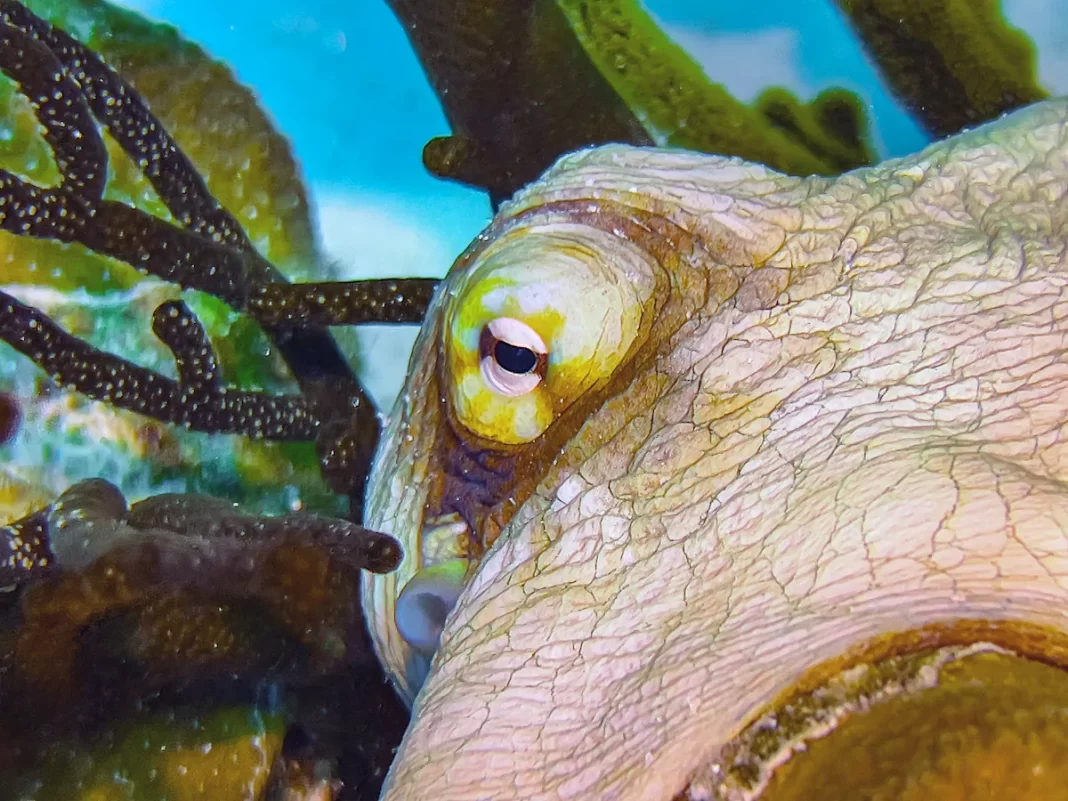

Just when you thought you understood your place in the universe’s intelligence rankings, science comes along to ruin your week. Researchers at Dartmouth have confirmed that octopuses — those squishy, boneless, eight-armed weirdos — can learn to use a mirror to find food they can’t directly see. Cool for them. Deeply unsettling for the rest of us.
Here’s the setup: scientists put three California two-spot octopuses in front of a mirror and hid a virtual crab somewhere behind them, visible only in the reflection. To get the snack, the octopus had to look in the mirror, figure out the crab wasn’t actually in the mirror, turn around, and go find it in real life. That’s not “ooh, shiny” behavior. That’s spatial reasoning. That’s the kind of thing toddlers struggle with. (Not to mention your lazy ex.)
And they were good at it: the octopuses picked the correct direction about 73% of the time, getting faster with practice. Some of them even climbed straight over the side of their tank to get to the food rather than taking the scenic route, which feels less like “animal behavior” and more like someone who’s done this before and is tired of your questions.
Until now, this kind of mirror-based tool use had only been seen in vertebrates — some mammals, some birds, your dog occasionally barking at himself like a fool. Octopuses just joined that club uninvited, which is notable because, evolutionarily speaking, our last common ancestor with an octopus was a worm that lived 350 to 500 million years ago. We are not cousins. We’re not even really in the same neighborhood. And yet here they are, casually doing geometry homework that some vertebrates can’t manage.
The leading theory is that octopuses are basically underwater cats: stealthy hunters that sneak up and pounce, and want to do it fast so they don’t become someone else’s lunch in the process. Researchers think that kind of hunting style might rrequire a mental map of your surroundings — which would explain why an octopus brain, despite having approximately zero overlap with ours, evolved something that functions like one.

So, to recap: octopuses can change their skin texture and color in an instant, squeeze their entire boneless bodies through gaps the size of a coin, regrow lost limbs, and now, apparently, understand reflections well enough to use them as a GPS to snacks. They have nine brains, blue blood, and better spatial reasoning than half the people who’ve ever tried to parallel park.
I’m not saying the octopuses are planning anything, for the record. I’m just saying that if you see one looking unusually thoughtful in a tide pool this summer, maybe don’t make eye contact in the mirror.
If you love nature and travel as much as I do, I’d love if you could follow me on Yahoo Creators for more articles on our wild world. This shows the Yahoo team what their readers want — and the more brands that support the planet, the better.