
One year after Bryan Kohberger was sentenced to life in prison for the 2022 murders of four University of Idaho students, a new Netflix documentary will examine the brutal crime.
The Idaho Murders: College Nightmare will chronicle the crime and its aftermath, including the weekslong manhunt for the then-suspected killer. It will pay special attention to the victims — Madison Mogen, 21; Kaylee Goncalves, 21; Xana Kernodle, 20; and Ethan Chapin, 20 — who were found stabbed to death in their off-campus home in the quiet town of Moscow, Idaho, according to Netflix’s Tudum.
“At a time when so much attention has been focused on the case itself, I felt it was important to create something that brings the focus back to who they were, the lives they lived, and the love that still surrounds them,” director Skye Borgman, whose previous documentaries include Unknown Number: The High School Catfish, told Tudum.
Ahead of the documentary’s release, here’s a refresher on the Idaho murders case and where it stands now.
The night of the murders
On Nov. 13, 2022, just after 4 a.m., investigators say Kohberger, then a 28-year-old criminology PhD student at Washington State University, entered the off-campus rental house at 1122 King Road in Moscow through a sliding kitchen door.
Kohberger went up to the third floor and killed Mogen and Goncalves with a knife, leaving the knife sheath — which would later connect him to the crime — next to Mogen’s body. After killing Mogen and Goncalves, he encountered Kernodle, who had recently received a food delivery, and killed her. He then killed Kernodle’s boyfriend, Chapin, who had been sleeping in her room.

From left to right: University of Idaho students Madison Mogen, Kaylee Goncalves, Xana Kernodle and Ethan Chapin.
(Idaho Statesman graphic/Tribune News Service via Getty Images)
There were two other roommates in the house that night: Dylan Mortensen and Bethany Funke. According to court documents, Mortensen said she woke up to crying and strange noises. She opened her bedroom door and saw a man dressed in black walking toward her, prompting her to lock herself in the room.
Phone records show Mortensen tried calling and texting the victims, but got no response. She then woke up Funke, who slept through the stabbings, with text messages telling her that a man wearing what looked like a ski mask had been in the house, CNN reported. Mortensen joined Funke in her room, and the two tried texting and calling their roommates, who did not respond.
A 911 call was placed just before noon to report that Kernodle was unconscious. Moscow police arrived to find the four victims dead.
How was Bryan Kohberger caught?
To this day, investigators have not identified any known connection between Kohberger and the victims.
The DNA found on the knife sheath did not initially match anyone in the FBI’s database. Investigators sent the DNA sample to a private lab to search for genetic relatives through publicly available genealogy databases. The search was successful, and investigators began building family trees to identify possible suspects.
Meanwhile, in late November, investigators were also looking for a white Hyundai Elantra that surveillance cameras captured driving around the crime scene at the time of the murders. Washington State University police identified one registered to Bryan Kohberger, making him a key suspect.

A makeshift memorial at the site of the quadruple murder in Moscow, Idaho.
(David Ryder via Getty Images)
Using search warrants for Kohberger’s phone records, investigators tracked him to his parents’ Pennsylvania home, which he visited in late December. They recovered trash from outside the home and a lab confirmed that the DNA found on the trash belonged to the biological father of the male whose DNA was found on the knife sheath. Kohberger was arrested on Dec. 30, 2022.
Bryan Kohberger’s trial
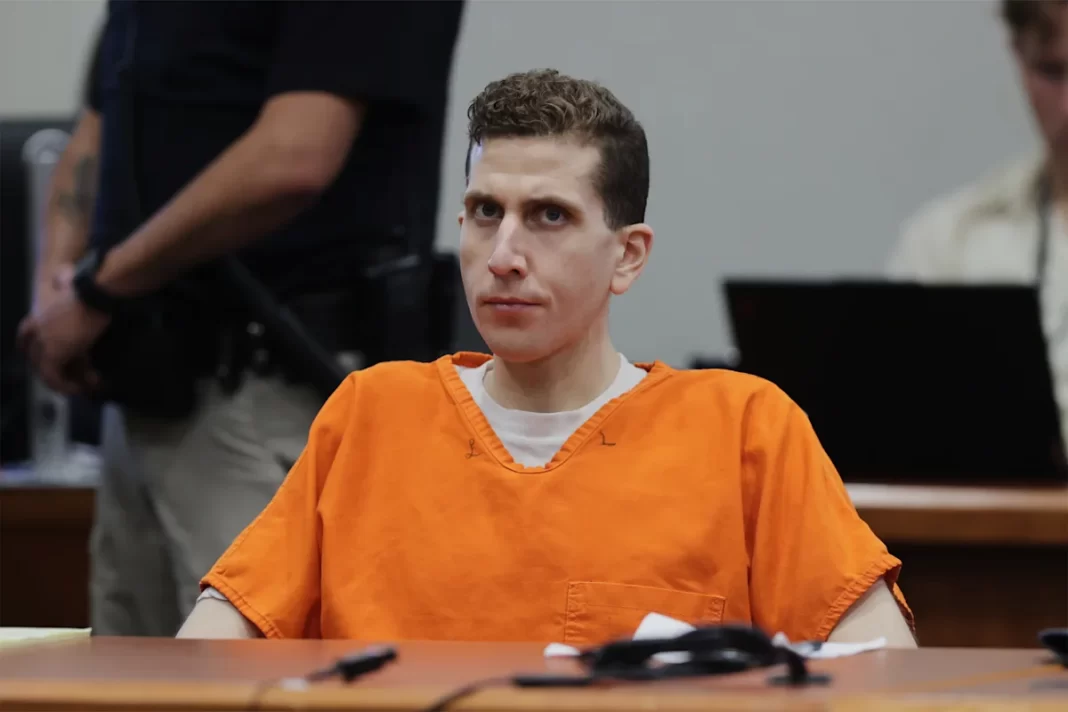
Kohberger was charged with four counts of first-degree murder and one count of burglary, charges that made him eligible for the death penalty. He accepted a plea deal on June 30, 2025, and formally pleaded guilty in court on July 2, 2025.
Kohberger spoke publicly in court for the first time at the July 2 hearing, answering “yes” when the judge asked whether he had killed each of the victims and “guilty” when asked for his pleas to the charges.
On July 23, 2025, the families of the victims spoke directly to Kohberger during his sentencing.
“You’re a delusional, pathetic, hypochondriac loser who thought you were so much smarter than everybody else,” said Alivea Goncalves, sister of Kaylee Goncalves. “You aren’t special or deep, not mysterious or exceptional. … No one thinks you are important.”
Kohberger was sentenced to four consecutive life sentences for the murders, as well as the maximum penalty of 10 years for burglary. He did not receive the death penalty.
Has Bryan Kohberger ever explained his motive?
No, he has not. Although prosecutors could have required Kohberger to explain his motive as part of his plea deal to avoid the death penalty, they ultimately chose not to.
“I don’t believe there is anything that would come out of his mouth that would be the truth,” Thompson said at a news conference after Kohberger’s sentencing. “I don’t believe there is anything that would come out of his mouth that wouldn’t be self-serving, and I don’t believe that there’s anything that would come out of his mouth that would not further victimize the families.”
Others, however, hoped that Kohberger would reveal his motive, including President Trump, who wrote in a Truth Social post, “While Life Imprisonment is tough, it’s certainly better than receiving the Death Penalty but, before Sentencing, I hope the Judge makes Kohberger, at a minimum, explain why he did these horrible murders. There are no explanations, there is no NOTHING.”
The Idaho Murders: College Nightmare arrives on Netflix July 29.