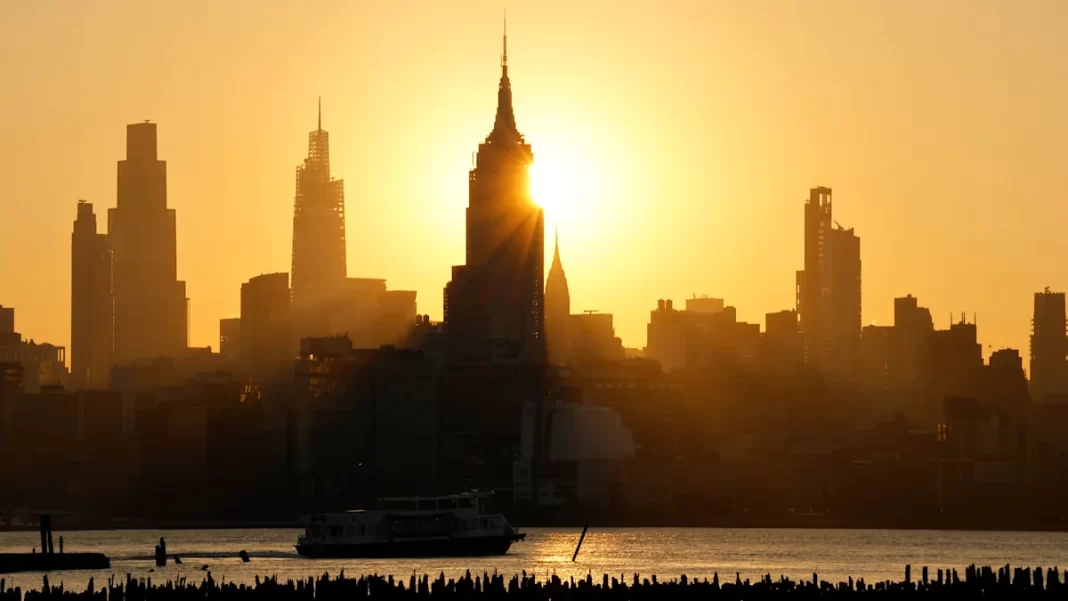

At least 17 states were under air quality alerts on Thursday as smoke from Canadian wildfires blanketed new portions of the Midwest and Northeast.
The alerts expanded to several more states as the stream of smoke spread further east and south, affecting more than 125 million Americans from Minnesota all the way to Massachusetts, New York and other parts of the Northeast. Air quality is particularly bad in Minnesota and Michigan. At certain points on Thursday, parts of northern Minnesota surpassed an Air Quality Index reading of 1,000 — the highest in the country. An AQI above 100 is considered unhealthy, while a reading over 300 is considered hazardous.
The National Weather Service forecast the smoke to continue affecting the region through at least Friday.
The unhealthy conditions have raised questions about the safety of the World Cup final between Spain and Argentina, which is scheduled to be played in New Jersey on Sunday. Forecasters expect conditions to improve by the weekend, with rain predicted to help dissipate the smoke on Saturday. No official air quality forecast for match time has been released, but some smoke could still linger in the area when it kicks off. As of now, there are no plans to relocate or postpone the match due to the smoke.

Smoke forecast for 6 p.m. ET Thursday, July 16, in the continental United States. Red and purple regions indicate areas with the highest smoke concentration.
(National Oceanic and Atmospheric Administration)
Where are the fires exactly?
The smoke is coming from hundreds of active wildfires burning across Canada. On Wednesday afternoon, the country’s wildfire monitoring agency listed more than 850 active fires, including 188 that were categorized as “out of control.”
Wildfire smoke is impacting parts of the U.S. that were already enduring a major heat wave, which has led the National Weather Service to issue major or extreme heat risk alerts for 68 million Americans.

Air quality forecast for Thursday, July 16.
(U.S. Environmental Protection Agency)
Why is wildfire smoke dangerous?
Smoke from wildfires is filled with harmful gases and small pieces of particulate matter that can cause a wide range of serious health problems for people who are exposed to it.
“Fine particulate matter from wildfire smoke is particularly dangerous because it can penetrate deep into the lungs and enter the bloodstream, potentially causing damage to multiple body systems, including the cardiovascular and nervous systems,” Jessica Yu, a research scientist at Stanford University, said in a panel discussion at the school last year. Yu’s coresearcher, Lisa Patel, estimated that wildfire smoke is “10 times as toxic” as typical air pollution.
Smoke is especially dangerous for members of sensitive groups, including people with heart or lung disease, the elderly, small children and anyone who might be at risk of extended exposure, including outdoor workers.
How to stay safe
Health experts say the No. 1 way to protect yourself from wildfire smoke is to limit your exposure as much as possible. Avoid going outside unless it’s absolutely necessary and keep trips short whenever possible. Resources like AirNow, the federal government’s national air quality monitoring system, can help you understand how severe the risk is and plan accordingly.
If you are going to go outside, health officials advise that you wear a mask, but not all masks will get the job done. Experts say surgical masks, like the ones that were most commonly used during the COVID-19 pandemic, offer only minimal protection from the particulate matter in wildfire smoke. Respirator masks, such as an N95, are much more effective.
While indoors, it’s important to keep all windows and doors securely shut. Running the air conditioner can help filter particulates out of the air, but ensure that the system is recirculating air that’s already inside the home, not pulling in new air from outside. Using a commercial air filter, or fashioning your own using a fan and other household items, can be beneficial.
Officials also recommend turning part of your home into a “clean room” that is especially insulated from wildfire smoke, where all members of the household can gather together until the risk has passed.