
NORTH BLENHEIM – Lifelong Cobleskill resident Jeffrey VanDeusen began working for Niagara Mohawk Power Co. as a journeyman lineman in the summer of 1982.
Ronald Reagan was in the White House. “E.T. the Extra-Terrestrial” was playing in theaters.
VanDeusen, 69, spent 32 years with the utility, now called National Grid, before officially retiring in 2013 as an overhead line supervisor. Over those decades, he dealt with the aftermath of destructive storms that left customers without power.
None compared to Tropical Storm Irene, which hit upstate New York on Aug. 28, 2011.
In a place like Schoharie County, with a population of just 30,000, the 15th anniversary is deeply personal to VanDeusen and other National Grid employees who witnessed Irene’s consequences.
Photo essay: Tropical Storm Irene pummeled the region 15 years ago
Many customers lost more than power: They lost homes and businesses, inundated or swept away by the unprecedented flooding that followed when Irene drenched the Schoharie Valley.
At the time, VanDeusen and his family lived on Mineral Springs Road, about a mile from the National Grid service center in Cobleskill where he supervised 15 crews. Unlike many, he was doubly lucky: The elevation of his home and office was high enough to be spared from flooding.
“Surprisingly, that afternoon, the sun came out,” VanDeusen said. “But the damage had been done. Roads were washed out, buildings and towns and villages were completely flooded, and we still couldn’t get into these locations. And by Tuesday, we were still not able to really put boots on the ground. And we didn’t even have enough crews at that point to handle all the 911 calls.”

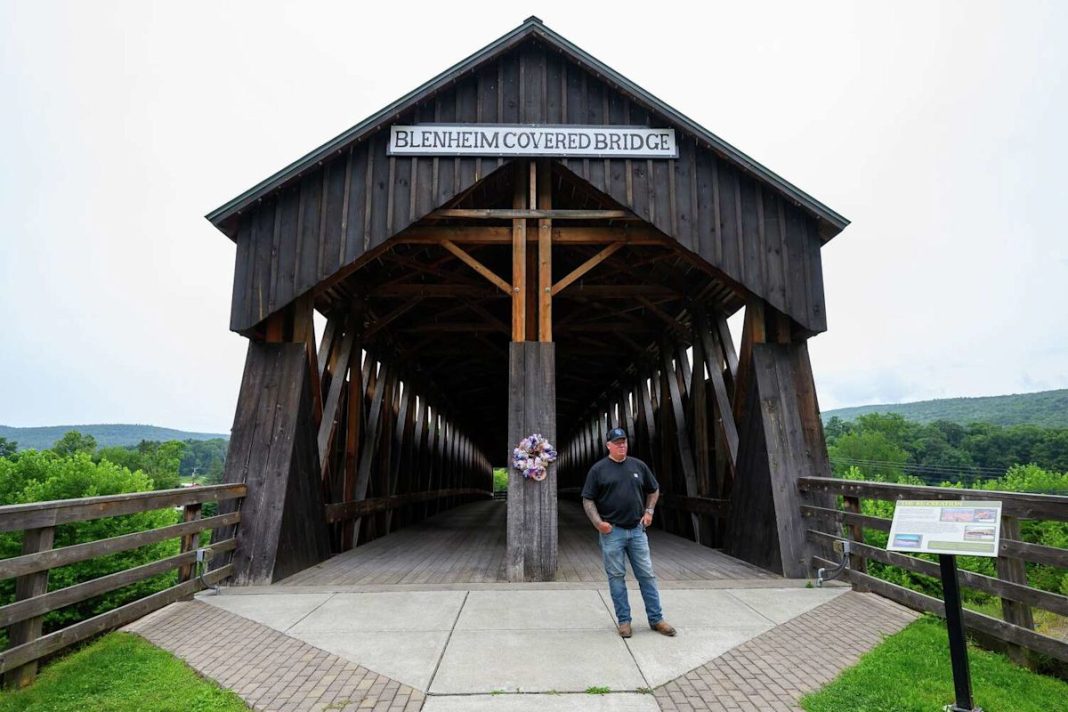
The Blenheim Covered Bridge, seen on Aug. 20 in North Blenheim, was destroyed when the Schoharie Creek flooded 15 years ago during Tropical Storm Irene. It has since been rebuilt. (Jim Franco/Times Union)
Although his home, about a mile from National Grid’s service center on Route 145, was spared, many of his friends and family members were much closer to the flood zone.
But VanDeusen says the people of the Schoharie Valley are resilient survivors who have witnessed many other disasters. And it is the repeated ebbs and flows of the rivers and tributaries here that have created the fertile soil that has sustained generations of farmers.
“These lowlands at the banks of the rivers, it’s all fertile soil from years and years of floods that have washed in the silt,” he said.
And to VanDeusen, nothing symbolizes that enduring spirit of regeneration more than the Old Blenheim Covered Bridge that sits high above the Schoharie Creek in North Blenheim, about 15 miles southwest of Middleburgh.
At more than 200 feet long, the original 1855 span, an engineering marvel of its time, was swept away when the water levels in the creek rose to unprecedented levels. It was listed as a National Historic Landmark before it was destroyed. The current replica, which includes pieces of the original, opened in 2019 and cost $6.8 million to build. FEMA covered 75% of the cost.
On the second day after the flooding struck, VanDeusen got into a National Grid helicopter to survey the damage from above. As always when he responded to outages and property damage, he brought his 35mm camera to document the destruction. The power company’s Cobleskill district spans hundreds of square miles from Esperance and Sharon Springs to the north and North Blenheim and the town of Broome to the south.
What VanDeusen witnessed was like nothing he had ever seen before.
But he was equally unprepared for what happened as he flew south of Middleburgh.
“When I got into the North Blenheim area, I said to the pilots, ‘My God, I can’t believe the Blenheim Bridge is gone,” VanDeusen said. “Prior to getting this far south in a helicopter, we’d seen washed-out roads, buildings completely washed away, power lines were gone. It was really starting to get pretty surreal. But when I got to here and saw the bridges gone, I just couldn’t even fathom how much water had come through here to destroy the bridge.”
The economic damage from Tropical Storm Irene was estimated to be as much as $150 million in Schoharie County alone, and more than $1 billion statewide.
VanDeusen ended up taking the photos he took that day and over subsequent weeks and made them into a book. Thousands of copies were sold at $15 each, raising nearly $70,000 for storm victims.
“That is one of the prouder moments that I was able to put that together and help the people out,” VanDeusen said.

National Grid spokesman Patrick Stella shows off the book that Jeffrey VanDeusen published in 2011 as a fundraiser for flood victims of Tropical Storm Irene. (Larry Rulison/Times Union)
A triple weather whammy
What made Tropical Storm Irene so unique, and why it remains so seared into the memory of VanDeusen and other National Grid employees, is that the region actually suffered three freak weather events in close succession.
That included a tornado with 110 mph winds that touched down near Amsterdam on Sept. 4, 2011, just one week after Irene struck, continuing 7 miles east to West Glenville, decapitating utility poles and trees and damaging dozens of buildings.
That was followed by the arrival of the remnants of Tropical Storm Lee, which hit New York three days later and caused more flooding.
For utility workers and first responders, it seemed as if Mother Nature kicked them when they were already down. And then kicked them some more.
“I certainly remember that day like it was yesterday,” said VanDeusen, who came into work that Sunday at 5 a.m not knowing how terrible the storm would turn out. “It was raining pretty hard at the time, although none of us were aware that the storm was going to turn out to be like this.”
He said only a few inches of rain had been expected, which is enough to cause some flooding.
“That’s somewhat what was predicted at the beginning of Irene, that we weren’t supposed to get this much water,” he said. “But as it turns out, we did. We’re talking 11 to 12 inches of rain that we received, which no one was prepared for.”

Aerial view of the Hudson River in Troy showing flooding following Tropical Storm Irene. Heavy rains swelled area rivers and creeks beyond capacity. (Will Waldron/Times Union)

Natasha Shuster, co-owner of the Catskill Mountain Country Store, cleans up from the damage caused by Hurricane Irene in Windham. Two cars ended up in the shattered parking area in front of the store. (Philip Kamrass/Times Union)

Pedestrians walk underneath a damaged, inactive power line on Main Street, caused by Hurricane Irene continues, on Monday Aug. 29, 2011, in Windham, NY. (Philip Kamrass / Times Union) (Philip Kamrass/Times Union)
Keith McAfee, who is now retired and living in South Carolina, was in charge of all of National Grid’s electric operations in New York when Irene landed. He worked 22 consecutive days as the incident commander in charge of everyone and everything in the wake of the storms and the twister.
The tornado crossed the Thruway and somehow didn’t kill anyone. Funnel clouds are pretty rare in upstate, McAfee said.
“And the damage is isolated, very isolated, but the damage is beyond significant,” McAfee said in a video interview last week with the Times Union. “It’s just like somebody wipes everything out, so we had that situation that occurred. It was in a very targeted location and we flooded that area with with resources and we, we got through that in a couple of days.”
Then came the blow from Lee, “which wasn’t supposed to be much of anything,” McAfee said.
“I was up in the Adirondacks because I was visiting employees that were working up north and I was in a hotel room (in Potsdam) and the phone rang. It was Eastern Regional Control Center calling me. It must have been like 2 in the morning. We had lost the transmission line that goes across the Mohawk River out of our Amsterdam substation. A transmission tower that carried the line over the river had been swept away. And the line was lying over the CSX tracks and the slack was in danger of pulling down another tower up on a hill on the other side. Disaster was looming.”
He added: “So I sort of bundled up my stuff, got a couple more hours’ sleep, got in my car and drove down to Amsterdam. And when I got to the substation, I was there with some of our civil engineering folks and our tradesmen, and I was watching our substation footprint fall into the river. Obviously that would have been a significant event if we lost equipment into the river. But we saved all that through a very heroic, stressful day.”
National Grid needed a helicopter to get the transmission line up and running again to avoid the CSX tracks.
“The railroad has their business and my business wasn’t their priority, so navigating all that with a helicopter contractor to run that conductor, those memories will stick with me for the rest of my life,” McAfee said.
Lasting effects
A new transmission tower has since been installed along the Mohawk, and a new substation was built west of there in the town of Florida near the Amsterdam city line. The old substation was decommissioned.
Last Friday, longtime National Grid communications manager Patrick Stella revisited the old steel structure, which sits next to Lock E10 of the Erie Canal. He had only started with the company about five years before Irene. It remains a seminal event for him and the company.

National Grid spokesman Patrick Stella at Lock 10 in Cranesville back in 2011 after a transmission tower was pulled into the Mohawk River in the wake of Tropical Storms Irene and Lee, which dropped heavy rains on the region in late August and early September that year. (National Grid)
“I’ve never seen anything quite like that,” Stella said. “I had lost power at my house in Niskayuna for a couple of days, but not as much as some of the other people that were affected by the floods.”
National Grid’s response to Irene and Lee became points of pride, and also provided lessons for future storm responses.
“You know, you didn’t get much of a minute to think about what was going on at the time, but I do know this: Ever since then, I kind of measure any other storm against Irene,” Stella said. “Whenever I’m talking about a storm, it’s like the benchmark of storms, and I always kind of joke about the fact that I hope it stays that way because if it doesn’t, that means there was a worse storm that’s going to come, and I don’t want to see that.”
Kimberly Ireland, director of external and community affairs for eastern New York at National Grid, has worked for the company for 18 years. She remembers that clearly. It happened to be her daughter’s birthday.
“Irene was the only person that showed up at my daughter’s birthday party that morning,” Ireland said. “Irene broke my 6-year-old daughter’s heart.”

Kim Ireland, director of external and community affairs for National Grid’s eastern New York operations, and Jeffrey VanDeusen, a retired district line supervisor from Cobleskill, talk about the 15th anniversary of Tropical Storm Irene at the Blenheim Covered Bridge (Jim Franco/Times Union)
The company has put in place many new enhanced policies and procedures since Irene and Lee. Among those is more people who normally work out of an office being assigned specific operations tasks during storms.
“So we have people who may be working in the energy efficiency department on their normal blue-sky day. But when there is an emergency, they are assigned, for example, to dry ice if we need to distribute dry ice,” Ireland said. “So we make sure that we have the bandwidth within our current team to do that work for when we need to back up our operations folks.”
Subscribe
There’s more to Albany with the Times Union. Subscribe today for just 25¢.
This article originally published at Irene, Lee and the tornado: The storms that changed everything 15 years ago.