
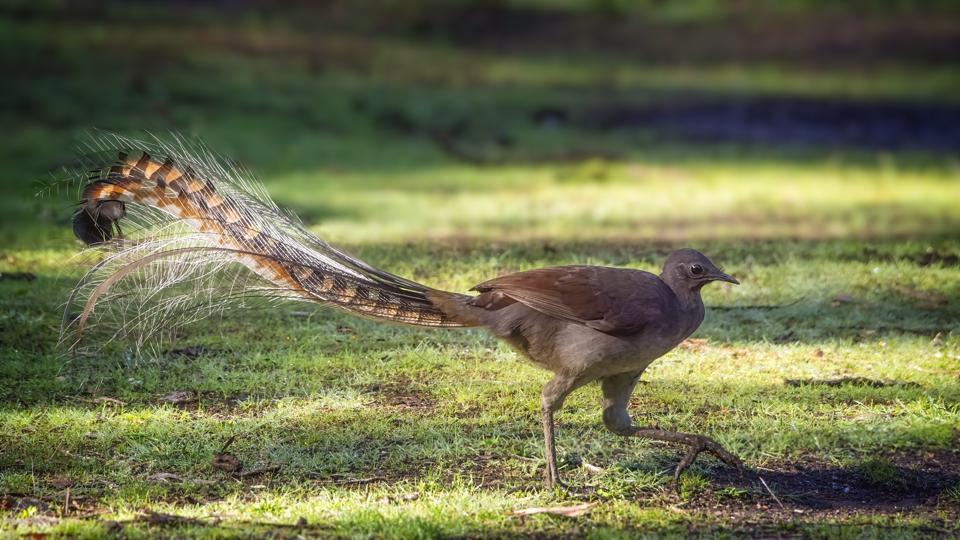

The first time you hear a superb lyrebird, it doesn’t quite sound like a bird at all. It sounds like a forest remembering itself: a whipbird’s crack, a kookaburra’s laugh, the chatter of unseen species stitched together uncannily yet familiarly. And sometimes, unsettlingly, it even mimics us.
For decades, the superb lyrebird (Menura novaehollandiae) has been described as the most accomplished mimic in the animal kingdom. That’s a bold claim. But when you look closely at the research, it starts to feel more like a careful understatement.
What Makes Lyrebirds The Most Accomplished Mimics
What sets lyrebirds apart isn’t just that they mimic. There are various species, common and uncommon, that can achieve this, from parrots to mockingbirds. Instead, what distinguishes lyrebirds is how well they mimic and how strategically they deploy that ability.
In a 2012 study published in Animal Behaviour, researchers put their mimicry to a rigorous test. The authors focused on the lyrebird’s imitation of the grey shrike-thrush (Colluricincla harmonica), a common Australian songbird that has a distinctive and complex call. The researchers approached the question from two angles: perception and acoustics.
They started by conducting playback experiments. If lyrebirds are merely approximate imitators, they expected that the shrike-thrushes would be able to differentiate between their own species’ song and a lyrebird’s imitation. But they didn’t. In fact, the birds responded just as strongly to the mimicked song as they did to genuine shrike-thrush calls. In other words, from the listener’s perspective, the lyrebird’s imitation passed as the real thing.
Then, the researchers went deeper by analyzing the acoustic structure of the sounds themselves. These analyses confirmed just how remarkably similar the lyrebirds’ imitations were to the original songs, both in structure and complexity. They preserved the essential architecture of the sound with striking fidelity.
However, there was one tell the researchers identified that distinguished them from the shrike-thrushes: lyrebirds tended to produce fewer repetitions of certain elements compared to the original. The researchers interpreted this as a trade-off. Instead of perfectly reproducing every detail of one species’ call, lyrebirds evolved to balance the accuracy of their mimicry with variety; they compress certain elements to make room others, giving them a broader repertoire overall.
This is precisely what elevates lyrebirds as mimics. Many animals can imitate others, but few can do so with such precision and breadth. Lyrebirds go above and beyond by integrating dozens of species’ calls into a single, fluid performance.
Beyond the lab, there’s also a wealth of observational evidence suggesting that their repertoire isn’t solely limited to the natural world. Lyrebirds have been recorded incorporating human-made sounds into their displays: chainsaws, camera shutters, car alarms, engine noises, even crying babies and fragments of human speech. And in many cases, they’re eerily precise in terms of the rhythms, tones and mechanical cadence.
However, these examples typically come from individuals that live in close proximity to humans, often in captivity or heavily visited habitats. Human-made sounds in these environments are repeatedly available to learn. But that’s exactly the point.
Lyrebirds don’t seem to privilege “natural” over “artificial” inputs. Instead, they operate as opportunistic acoustic learners by absorbing and reproducing whatever dominates their soundscape. In that sense, their mimicry serves to map their environment in sound, whether that environment is a dense forest or one increasingly shaped by human presence.
How And Why Lyrebirds Mimic So Well
Like other songbirds, lyrebirds are vocal learners. They don’t rely solely on innate calls; instead, they acquire sounds through imitation, memory and practice. This places them in a relatively exclusive club that includes parrots and only a handful of other highly flexible vocal learners.
Their vocal organ (the syrinx) is what enables their fine-grained control over the pitch, timing and tonal quality of their calls. Their cognitive capacity also matters to this end, as it determines their ability to store detailed acoustic templates and reproduce them with precision.
Still, the more interesting question is not how they mimic, but why they go to such lengths to perfect it. A 2022 study in Evolutionary Ecology offers a compelling answer: mimicry in lyrebirds is deeply tied to sexual selection. Male lyrebirds perform elaborate courtship displays that combine movement and sound. During these performances, they don’t just cycle through a random assortment of calls. The researchers observed that they deploy specific sounds at specific moments.
One component of this display is what the researchers refer to as “D-song.” During D-song, males mimic the alarm calls of multiple other bird species, which creates the acoustic illusion of a mixed-species mobbing event: a chaotic chorus of different species’ calls that erupts when birds collectively respond to a predator.
The study found that nearly 80% of lyrebirds’ D-song included alarm-calls from three other species. What was notable, however, is that these calls didn’t come from the most common birds in the environment, as most would expect; they didn’t come from the rarest birds, either. Instead, they consistently mimicked species that typically forage alongside lyrebirds, which would be most likely to participate in real mobbing flocks.
In other words, male lyrebirds aren’t just mimicking arbitrarily. They actively reconstruct believable ecological scenes with their songs. The question is: why?
The researchers argue that this may function to exploit the antipredator instincts of female lyrebords. By simulating a predator-related event — specifically, the chaotic chorus of alarm calls that typically signals danger — males are essentially able to direct a female’s attention into a heightened, vigilant state. In the wild, these mobbing calls are rarely ignored; they’re urgent, information-rich cues that demand a response.
Therefore, by recreating this acoustic scenario within a courtship display, the male can manipulate the behavioral context in which the interaction unfolds. He essentially inserts his display into a moment that, for the female, feels consequential or attention-worthy.
One possibility is that this heightened arousal makes females more attentive to the male’s performance that follows. Another is that it could also tap into their pre-existing sensory biases; by leveraging signals that already carry meaning, they don’t have to build new ones from scratch. Either way, it reframes mimicry as something more strategic than decorative.
Why Lyrebirds Evolved Such Extreme Mimicry
To the uninitiated, the lyrebird’s repertoire might seem almost excessive. Why would evolution favor such complexity, when countless birds rely on simpler signals that suffice? The answer likely lies in the dynamics of sexual selection, where, beyond communication, signals matter in terms of competition and persuasion.
In many species, males evolve beautiful and elaborate traits to attract mates: bright plumage, intricate dances, complex songs. In the bird world, these traits serve as an honest signal of the male’s quality as a suitor. These traits are costly to produce and difficult to fake, which therefore makes them informative.
Lyrebird mimicry fits neatly into this framework, only with a touch more sophistication. To build and maintain the large and accurate repertoires that male lyrebirds are known for, they have to:
Be exposed to a wide range of sounds
Accurately perceive and memorize them
Reproduce them with fine motor control
Integrate them into coherent sequences
Each of these steps places its own demands on the individual. But together, they create what could almost be considered a cognitive and physiological gauntlet, in which only high-quality individuals can likely excel.
But there’s also a cultural dimension. Because lyrebirds learn their sounds from the environment, their repertoires are a reflection of their unique local acoustic communities. This means that, beyond being biologically driven, their displays are also culturally shaped. They will naturally evolve over time, as sounds enter and leave the environment.
This opens the door to a feedback loop: as females prefer more complex or novel displays, males are under pressure to expand and refine their repertoires. This, in turn, raises the bar for future generations.
The element of illusion also benefits lyrebirds. By mimicking entire ecological events (like mobbing flocks), they tap into pre-existing sensory biases, saving them the energy required for inventing entirely new signals. It’s a clever strategy. Why evolve a signal from scratch when you can co-opt one that already commands attention?
The more you learn about the superb lyrebird, the harder it becomes to categorize. It is, all at once, a mimic, a performer and a manipulator of soundscapes. Some might say that it’s merely copying its environment. But, in reality, it’s simultaneously interpreting it, reshaping it and using it to tell a story that — if the research is right — has been honed over generations to captivate exactly the audience that matters most.
The lyrebird is a powerful reminder that to mimic nature, you first have to notice it. Take the Connectedness to Nature Scale to explore your own connection to it.
This article was originally published on Forbes.com