
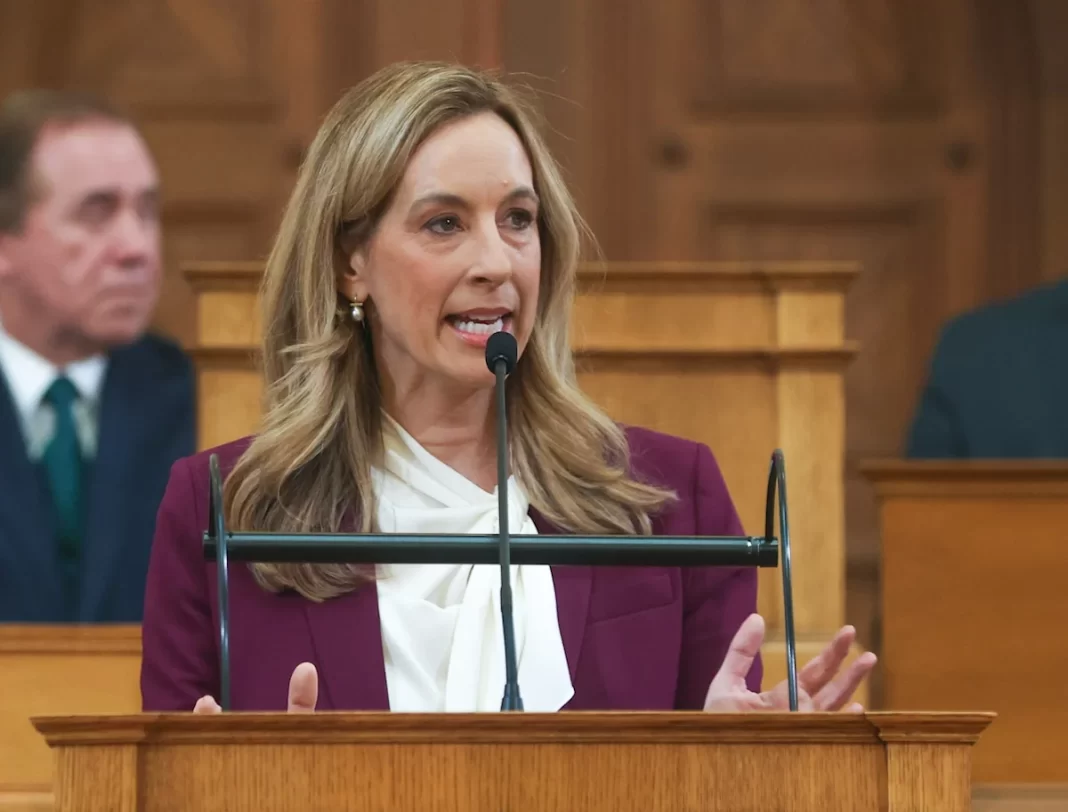

State Senate and Assembly budget committees voted along party lines in a rare Sunday session to advance a record $60.7 billion state budget that contains a a scaled-back and revamped property-tax break for seniors, a full pension payment for public workers, and hundreds of millions of dollars for local projects in New Jersey.
Lawmakers rushed to approve the budget bill, which determines how the state government will spend taxpayer money in the upcoming fiscal year.
Sunday’s hearings at the Statehouse in Trenton set up a final vote by the 120-member state Legislature on Tuesday, when Gov. Mikie Sherrill must sign it into law before the new fiscal calendar starts and the state runs out of cash Wednesday.
Sherrill’s first budget since taking office in January is the largest in state history and also spends about $1.4 billion more than it takes in from taxes and revenue.
That, however, is down from the $3 billion gap Sherrill said the state faced earlier this year, and the Democratic governor has already touted the spending plan as proof positive she is carrying out the “affordability agenda” she campaigned on last year.
The budget also contains a temporarily expanded child tax credit for families, while Democrats note the plan includes a record amount of property-tax relief and does not come with any broad tax increases.
Assembly Budget Committee Chairwoman Eliana Pintor Marin, D-Essex, said there are “good things in this budget for everyone,” though she cautioned there is “never a perfect” budget.
Sherrill and her fellow Democrats who lead the Legislature benefitted from a surge of revenues, which grew by $677 million since she introduced her budget in March, according to budget documents released late Sunday. Some of that was used to bolster the state’s surplus, which is at $6 billion — money Democrats said is necessary amid uncertainty over federal aid and policies coming from Washington.
But there is also $389 million in new spending for the upcoming budget year.
In closed-door negotiations last week, Sherrill, Senate President Nicholas Scutari, D-Union, and Assembly Speaker Craig Coughlin, D-Middlesex, struck a compromise on how much extra money lawmakers would get for pet projects in their districts. Scutari and Coughlin would each get $200 million to distribute $400 million total — down from $700 million they added to outgoing Democratic Gov. Phil Murphy’s budget in June 2025.
Sherrill chastised fellow Democrats in her March budget address for their unchecked spending last year. That gave rise to optimism among Republicans — the minority party in Trenton — that Sherrill would make good on promises of reform and fiscal transparency and would engage more with their party.
But Republicans said that optimism was short-lived. As final negotiations hurtled toward a conclusion, GOP lawmakers said they were largely left out of the process and legislative add-ons — also known as “Christmas tree” items — were added without time for public review, similar to the budget itself.
Much of Sunday’s tension took place in the Senate chambers.
Senate Budget Committee Chairman Paul Sarlo, D-Bergen, blamed its down-to-the-wire passage in part on a “learning curve” and a “lot of give and take” that comes with a new governor.
“We are delivering today a balanced budget to the state of New Jersey,” Sarlo said.
But Sen. Declan O’Scanlon, R-Monmouth, the chamber’s Republican budget officer, said “this side of the aisle has to fault the last-minute nature of this process.”
“Fifteen minutes ago, I got 56 pages of line items and budget wording,” he continued. “Well, it’s impossible to go through that in that amount of time.”
Lawmakers also scoured the current year’s budget, found $358.8 million in unspent money, and repurposed it for different projects in a separate, supplemental bill (S4538).
Because the funds are from the current fiscal year, it helps keep the new budget roughly in line with the $60.7 billion price tag Sherrill proposed in March. That, critics say, helps the governor make the argument her inaugural budget is more careful with taxpayer money. O’Scanlon decried it as a “shell game.”
In the end, the budget is about $15 million more than Sherrill’s original proposal from March and $1.9 billion larger than the current budget Murphy left behind.
Among the $358.8 million re-spent in the current budget, lawmakers dedicated $174 million for unspecified local governments; $50 million for University Hospital in Newark, the state’s only public hospital; $40 million to cover expenses associated with hosting the FIFA World Cup; $17.6 million for “various health organizations;” $14.8 million for the Cooper Medical School of Rowan University; and $5 million for the South Jersey Cancer Program at Cooper University Health Care.
The Legislature, which has been controlled by Democrats for a quarter-century, adds money to lawmakers’ districts every year at budget time. Some of that money goes to nonprofits, food pantries, and other charitable efforts. Other portions are directed to more controversial “pork” projects, including construction contracts, jobs, and initiatives that can intersect with the interests of part-time legislators who hold full-time jobs.
Sherrill made widespread cuts, affecting many social service programs, sparking outrage among even Republicans. The budget introduced by the Legislature on Sunday night reversed many of those cuts. They included $2.1 million for the Court Appointed Special Advocate Program, which advises judges on foster children’s cases and $5.9 million for sexual abuse victims programs.
The Senate Budget and Appropriations Committee approved the budget by a 9-4 vote. The Assembly Appropriations passed it by a 11-vote. No Republicans supported it.
The final vote was cast at 11:45 p.m. Sunday — 15 minutes before the committees would have missed a deadline to approve the spending plan and send it for a floor vote Tuesday. The state constitution requires that budget bills sit for a full day before final votes.
The sprint has revived longstanding criticism from Republicans, progressive activists, and good-government advocates that state leaders often hurry the budget process, leaving lawmakers and taxpayers little time to scour the final document before votes.
“This isn’t normal. This isn’t right,” Assemblyman Mike Inganamort, R-Sussex, said. “The governor specifically promised (the budget process) would be different. She failed to deliver on that promise.”
Details of the budget
Stay NJ overhaul
The budget preserves but scales back Stay NJ, a property-tax relief program for residents 65 and older, by giving lower-income households the highest benefits.
Sherrill had originally proposed lowering the income threshold for eligible senior homeowners from $500,000 to $250,000. Lawmakers ultimately reduced it further to about $200,000 in the final budget deal.
The total maximum payout — currently $6,500 regardless of income — is also changing. Under the overhaul, those making between $150,000 and $200,000 will qualify for a payout of up to $4,000. Those making between $100,000 and $150,000 will qualify for up to $5,000. Those making under $100,000 will qualify for up to $6,500.
The program drew criticism when it was enacted last year because of concerns about its long-term cost, with analysts warning its price tag could grow significantly without a dedicated funding source. Sherrill and legislative leaders said the changes will make it more “sustainable.”
Republicans counter that the $200,000 threshold is too low and will kick off seniors who rely on the break.
Aid to Jersey City
Jersey City is set to receive $15 million more in state aid and be approved for an $105 million loan on top of that as new Mayor James Solomon said the city — the state’s second-largest — was left with a $255 million deficit.
Solomon was seeking $120 million in aid help fill the hole and prevent a massive property-tax increase.
School funding
The Sherrill administration devoted a record $12 billion in state aid for K-12 public school funding. But lawmakers from both sides of the aisle have indicated they wanted more as districts say they’re still coming up short and facing deep cuts.
School funding in the state is distributed under a formula put in place by Murphy’s administration. That formula has come under fire because it caps the amount of aid districts can receive, even though there was no cap on how much funding could be cut from districts in previous years.
Combined with some of the highest property taxes in the nation, school funding and its effect on tax rates in New Jersey has become one of the most high-profile fights during each budget season.
The Sherrill administration promised during this budget cycle to review and potentially revamp the formula but opted to keep it for now, citing limited time to develop a new system. Officials say reworking the formula is a priority in coming months.
Temporary boost to child tax credit
The committees Sunday also unanimously advanced a 25% expansion of the state’s child tax credit for the next three fiscal years.
This means a household earning $30,000 or under would receive a $1,250 credit, up from $1,000; families earning more than $30,000 but less than $40,000 would get $1,000, up from $800; those earning more than $40,000 but not over $50,000 would get a $750 credit, up from $600; those earning more than $50,000 but not more than $60,000 would get $500, up from $400; and families earning more than $60,000 but not over $80,000 would get $250, up from $200.
The expansion costs the state about $50 million.
Peter Chen, a senior analyst for the think tank New Jersey Policy Perspective, praised the expanded tax credit but questioned why lawmakers would allow it to expire after three years.
Taxing companies whose workers use Medicaid
The committees also approved Sherrill’s controversial fee on employers with 50 or more workers who rely on Medicaid for their health insurance. The state estimates it would raise $145 million in revenue.
Business groups fought the proposal, and in the end, the bill (A5324) spares companies in the second year from having to pay a fee for part-timers, seasonal workers, workers with disabilities and anyone hired within 90 days of the fee taking effect.
Upon sharp questioning from Assemblyman Al Barlas, R-Essex, Democrats on the budget committee couldn’t say how much the revenue would be raised once the exemptions take effect. One staffer said it may be only about $24 million.
The fee is staggered, based on how many Medicaid recipients a company employs. A company with 50 to 249 employees on public insurance will pay $325 for each employee and for each of the employee’s dependents. Employers with 250, but fewer than 500, Medicaid recipients would pay $525 for each employee, and each dependent, and $725 per employee and dependent for companies with 500 or more enrolled in Medicaid.
A 2024 state analysis found 132,000 private-sector workers and 249,323 of their dependents were on the Medicaid rolls, either because their employers do not offer insurance or the employees who meet low-income guidelines chose Medicaid because it costs them less. There were also 8,772 people in public-sector jobs, plus 17,080 of their spouses and children on Medicaid, also known as NJ FamilyCare.
Business leaders strongly opposed the fee, arguing it would penalize businesses who offer insurance coverage. They also predicted the law would not stand up to a legal challenge.
Jennifer Spiegel, an analyst for New Jersey Policy Perspective, testified against the bill because employers “may screen out applicants they perceive as likely to enroll in NJ FamilyCare.” The think tank suggested all employers should pay a fee instead.
NJ FamilyCare covers about 19% of all 9.5 million New Jersey residents.
Nicole Rodriguez, Policy Perspective’s president, said the budget overall takes “real steps” toward closing the state’s structural deficit “without cutting the programs” that families “depend on.”
“By closing tax loopholes and reducing the cost of the Stay NJ, the state is doing exactly what responsible budgeting looks like,” Rodriguez added. “At the same time, it invests in New Jersey’s working families with young children, immigrant communities, and transit riders who need help meeting costs today.”
https://widgetmaker.advance.net/widgies/stories-by-author/312ce5ad-1e62-4121-aae9-d3d7d1188de0
Read the original article on NJ.com. Add NJ.com as a Preferred Source by clicking here.