

Here’s what you’ll learn when you read this story:
During an archaeological mission meant to restore a gateway built by Pharaoh Ramses III, researchers discovered a stone stela showing a foreigner being crowned ruler.
Tiberius may have been a Roman emperor, but the sandstone block showed him dressed as a pharaoh and carrying out a ritual meant to uphold the cosmic order.
Previous Greek and Roman rulers—such as Alexander the Great, Trajan, and Claudius—had also been depicted and deified as pharaohs.
Ancient Egyptian scribes often wrote records on papyrus, and while some papyri have survived for several thousand years, many have all but disintegrated with time. The same cannot be said, luckily, of records chiseled in stone.
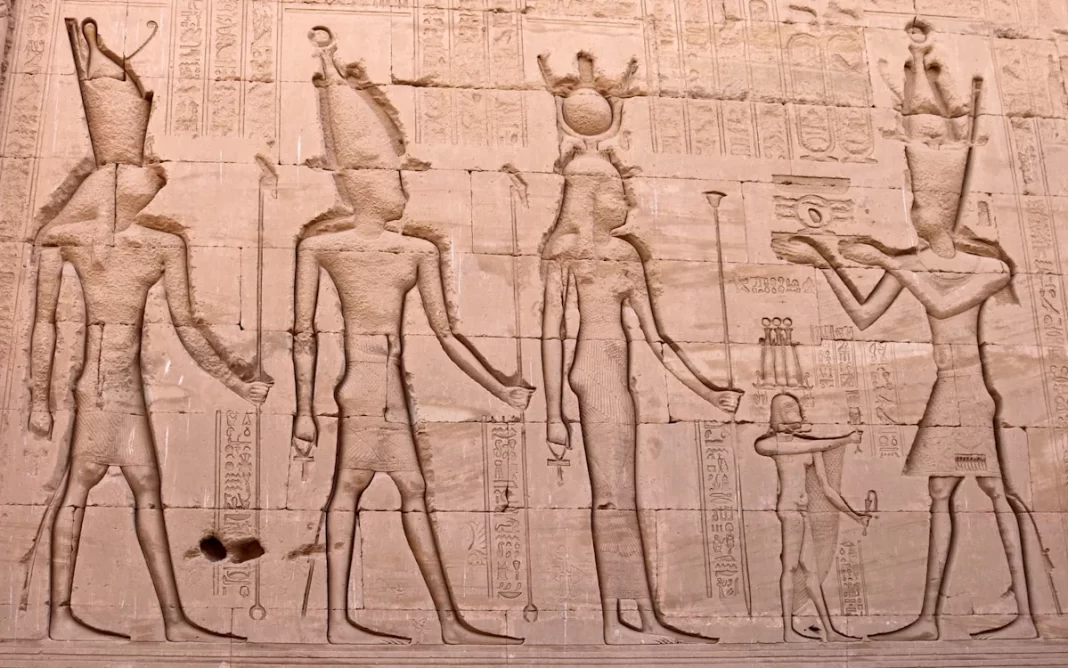
In the ancient world, stone pillars known as stelae were constructed to commemorate important events. The oldest stelae found in Egypt are burial markers from the First Dynasty, but they were used by cultures far and wild—from the Maya of Mesoamerica to the Assyrians, Greeks, and Romans. Recently, archaeologists unearthed another stela in Karnak, where they’d been working on the conservation and reinstallation of a wall from the reign of Pharaoh Rameses III. Found among the ruins of mud-brick houses and buildings from the late Roman and Byzantine periods, the stela is carved out of sandstone and, fascinatingly, depicts a foreign ruler—the Roman emperor Tiberius—standing among Egyptian deities.
Wearing the iconic double crown symbolizing the unity of Upper and Lower Egypt, Tiberius can be seen upholding the cosmic order—known as Ma’at and associated with the goddess of the same name. Portraying the Roman emperor and general Tiberius as a pharaoh of Egypt meant showing him performing rituals to appease the gods of the land that had been conquered by his predecessor, Augustus.
Like other Roman emperors, Tiberius was represented as pharaoh in Egyptian temples in continuation of a longstanding tradition, dating back through the Ptolemaic dynasty, of depicting the current ruler of Egypt within its ancient religious framework. Scenes painted or carved in temples, such as those at Dendera and Philae, show Tiberius dressed in the garb of Egyptian royalty and making offerings to Egyptian gods rather than the Roman pantheon. The recently discovered stela at the Karnak temple complex in Luxor offers another striking example. Tiberius stands among Amun-Ra (ruler of the gods), mother goddess Mut, and their son Khonsu—who together comprise what is known as the Theban Triad—immortalized above five lines of hieroglyphs that commemorate ancient renovations done on the wall of the Temple of Amun.
Roman emperors were often considered pharaohs, much like Alexander the Great was before them. They were drawn as Egyptians, had their faces stamped on Egyptian coins, and wrote their names in hieroglyphs within the same type of oval cartouches used for the bygone pharaohs of earlier ages. Emperor Claudius was engraved on the Temple of Isis at Shanhur, raising a temple for fertility god Min in one engraving and presenting Min with an offering in another. Trajan is shown smiting his enemies in a sandstone relief at the temple of ram-headed deity Khnum at Esna. Scenes like this were supposed to be idealized versions of rituals that may have been carried out, with people or statues standing in for the king and gods.
Led by the Franco-Egyptian Center for the Study of the Temples of Karnak—in cooperation with the National Center for Scientific Research and the Supreme Council of Antiquities—the archaeological mission (carried out between 2022 and 2025) revived the gateway of Rameses III. After carefully removing, restoring, and documenting each stone block of the structure, they used modern methods to reassemble it. Some already-decorated blocks, the team discovered, had been repurposed from the reign of Amenhotep III two hundred years earlier, meaning that the gateway was probably originally built during that older period and evolved with subsequent pharaohs. The team revealed multiple phases of construction, ranging from the New Kingdom through the Greek and Roman periods.
“The mission was able to discover a pavement that was first recorded at the beginning of the twentieth century,” a recent press release from the Ministry of Tourism and Archives states, “which connects the Gate of Ramses III and the Square of the Third Square within the temples of Karnak.”
You Might Also Like