
TALLAHASSEE, Florida — With hurricane season just days away, Florida’s emergency management chief Kevin Guthrie said the state is ready — and he expects the state to receive critical federal recovery funding faster than they have in recent years.
Guthrie, executive director of the state’s Division of Emergency Management, said Florida has the experience and resources to manage the 2026 hurricane season, even after this year’s historic wildfire season left tens of thousands of acres burned. The only thing holding back the state’s recovery from previous storms over the past two years, Guthrie said, has been the Federal Emergency Management Agency, which made changes two years ago that significantly slowed down the process used by states to request billions in federal funding.
Fights in Congress over the federal budget that led FEMA and other parts of the U.S. Department of Homeland Security to shut down for several weeks made things even worse.
“Nobody in the emergency management arena, Republican or Democrat, ever expected DHS to enact some of the policy regulations that were enacted,” Guthrie said. “That did slow the process down.”
But Guthrie said he believes changes recently enacted by newly appointed DHS Secretary Markwayne Mullin will relieve the disaster recovery funding bottleneck. Many of those changes had been recommended to DHS by Guthrie and other members of the federal FEMA Review Council. Mullin made the changes shortly after he was confirmed to lead the agency in late March.
“We’ve seen more money move in the last six weeks than we saw in the last 16 months,” Guthrie said. “None of us expected these slowdowns.”
After years of devastating hurricanes, Florida received a break last year. This year is also predicted to be comparatively quiet, with NOAA predicting a below-average hurricane season. Guthrie said one advantage this year is El Niño, a weather pattern in the Pacific Ocean typically delivering high-level winds over the Gulf that shred the tops of storms before they can grow into hurricanes.
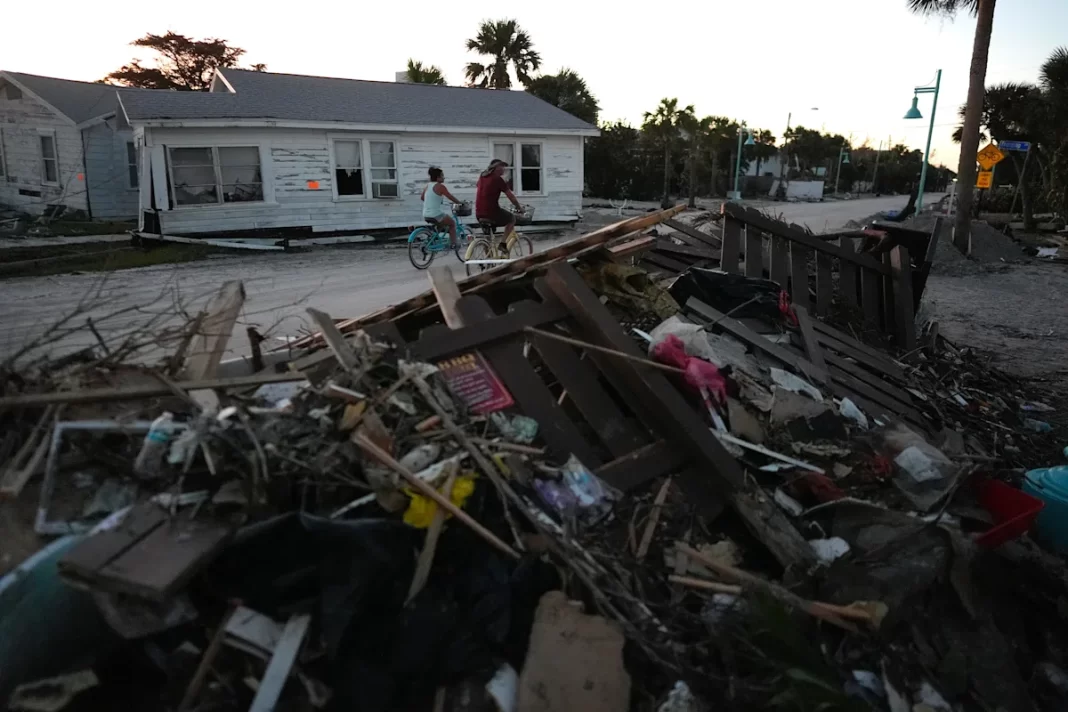
But the weather pattern’s effect isn’t a guarantee, and the state has learned from more than a century of dealing with hurricanes to always be ready. Storms like Hurricane Irma, which knocked out power to more than half the state in 2017, are capable of grinding Florida’s economy to a halt. And for a state that relies heavily on tourism to bring in tax dollars, recovery has to be fast.
“This is about time and the value of money,” Guthrie said. “The longer it takes for infrastructure to be up and running, the longer it’s going to cost down the road.”
Florida’s disaster expertise comes from its status as the country’s lightning rod for hurricanes, and the paths taken by recent storms have hit rural and inland areas not previously hit in decades. In 2018, Hurricane Michael unleashed winds of 162 mph before it made landfall east of Panama City and headed north across the Panhandle, impacting some of the poorest areas in the state.
When asked if the counties defined by the state as “fiscally constrained” are prepared for this year’s season, state Sen. Corey Simon (R-Tallahassee) said that since Michael, Florida’s Legislature has created funding options tailored to help rural cities and counties recover from disasters fast.
“That funding will always be there to help if they need it,” Simon said.
Florida Agriculture Commissioner Wilton Simpson said farms across the state’s heartland have endured droughts, hurricanes and a major freeze in the past five years. Simpson oversees the state Department of Agriculture and Consumer Services, which assists farmers with obtaining state and federal recovery funding, but Simpson said multiple years of repair costs are leading some small- and medium-size farms to close.
“Farmers have been whipsawed from major hurricanes or storms for the last four to five years, to a major freeze this year,” Simpson said. “It seems like just when you get back on your feet, something knocks you down.”
Simpson’s agency, which includes the state forest service, also has been taking a beating during this year’s wildfire season, with more than 136,000 acres torched by flames that raced across areas of state experiencing extreme drought. He said his agency still has the resources to help farmers restore order if severe storms come along. Many farmers also have since improved resiliency measures rather than risk getting hit by another storm or fire.
Simpson said even at his own egg farm in rural Pasco County, he planted a sturdy line of trees and built other natural barriers to protect barns from powerful winds. He also buried his powerlines.
Florida’s extensive experience with hurricanes has made it one of the fastest states at cleaning up after a storm. This urgency is also driven by the state’s economy, which relies heavily on tourism as its largest industry for tax revenue. Agriculture is another major industry, with the state ranking among the country’s top producers of vegetables, produce and cattle.
“We have to recover quickly, and that’s the key,” Simpson said.
Guthrie said a common misconception about DEM is that the agency addresses a disaster on its own, but the state fire service, for instance, led efforts to fight this year’s wildfires. The state Department of Health was also the lead agency for the Covid-19 pandemic.
“This is a team effort, and there is a lead agency,” Guthrie said. “There will always be a lead agency.”