
Amid a global revolt, FIFA President Gianni Infantino was forced on Friday to abandon his plan to sell billions of dollars’ worth of stakes in a new World Cup commercial entity to private investors led by Joshua Kushner — the brother of President Trump’s son-in-law, Jared Kushner.
“It has become clear that the project has created divisions of a nature that, regardless of the level of support, are no longer in the interest of the objective set out in the first place,” Infantino told Sky News. “As a result, this proposal will not proceed.”
Infantino’s retreat came a day after the 55 member associations of the Union of European Football Associations (UEFA) — a group that includes perennial soccer powerhouses such as Spain, France, England and Germany — unanimously threatened to boycott all FIFA competitions going forward.
FIFA is the governing body for international soccer and oversees the sport’s major international tournaments. UEFA’s boycott would have meant no European national teams at the 2030 World Cup in Spain, Portugal and Morocco — or at next summer’s Women’s World Cup in Brazil.
“The World Cup cannot be treated as an investment product. … Some things are simply too important to sell,” UEFA said in a statement. “The FIFA World Cup belongs to football. It always will. And so long as Europe has a voice, it will never be for sale.”
FIFA’s private investment plan, explained
The 2026 World Cup generated a reported $15 billion in revenue, shattering expectations, with VIP Trophy Lounge tickets for the final between Spain and Argentina selling for $34,500 apiece.
But as soon as the tournament ended, Infantino appears to have pivoted to other money-making opportunities. He also appears to have kept the Trump administration — and the president’s extended family — in the loop.
On Tuesday, the Times of London reported that Infantino was seeking to spin off a new company valued at about $20 billion, called FIFA Forward Enterprises (FFE), to run FIFA’s main events, including the World Cup. (FIFA is currently registered as a not-for-profit organization and reinvests its revenue in global soccer.)
In response to the report, FIFA issued a press release confirming that Infantino wanted to sell up to a 21% stake in the new company to private investors, with Thrive Eternal, Joshua Kushner’s long-term investment fund, “expected to lead the proposed investor group for FFE.” According to the Times, the Trump administration was aware of the plan before it became public.
Under Infantino’s proposal, FIFA would have retained majority control of FFE, and each of FIFA’s 211 member associations (like U.S. Soccer) would have received its own stake in the company. In addition, the new money generated by private investment — an estimated $4.2 billion — would have been “fully reinvested back into football worldwide” in the form of development grants that those same member associations could use to grow the game in their respective countries.
The Times also reported that Infantino would have likely run the new company after his term as FIFA president ended in 2031, with an annual salary on par with NFL Commissioner Roger Goodell’s: roughly $64 million. When asked about that figure, a FIFA spokesperson told the Athletic that Infantino’s potential involvement and compensation “has never been discussed,” but that “the FIFA president and administration will and must have leading roles in this entity” going forward.
Infantino currently earns about $6 million a year.
How did UEFA and others respond?
Infantino framed his FFE proposal as a way to “democratize” global soccer. “Our next stage of growth needs a structure built for it, one where the commercial side of the game operates as a focused, dedicated business, with its value shared more and better all around the world,” he said in a statement earlier this week. “Every FIFA member association should have an opportunity to seek a fair share of the available funding to shape its own future, deciding for itself rather than relying on others.”
But critics did not see it that way.
Some organizations initially objected to the secrecy surrounding Infantino’s plan. Concacaf — the Confederation of North, Central American and Caribbean Association Football — said it was “deeply concerned by the lack of due process” after it was “only made aware of this matter through media reports and, subsequently, via a media release.”
But the deeper worry was that private shareholders would reshape the sport itself. “The moment external investors acquire ownership interests in FIFA competitions, football changes forever,” UEFA said in its statement. “Commercial return becomes a permanent obligation. Investor expectations become a daily pressure. From that moment onwards, every decision on the international calendar, every decision on competition formats and every decision shaping the future of football is no longer driven by what best serves the game, but by what best serves shareholders.”
According to the AP, FIFA could have moved “to increase revenue and value for investors by playing World Cups and Club World Cups for men and women more often, along with adding more teams” — a change that might have disrupted existing league seasons and endangered player welfare by forcing even more matches onto an already congested calendar. Private investment might have also “incentivize[d] FIFA to further commodify the World Cup (think more hydration breaks and dynamic [ticket] pricing) in a drive to increase its revenue,” sports governance academic Antoine Duval told the AP.
Later Thursday, Concacaf released a statement saying its 41 member associations had “rejected” Infantino’s proposal. U.S. Soccer wrote on social media that it “stands with Concacaf and its members.” The Asian Football Confederation soon followed suit, saying it “stands in solidarity” with UEFA and Concacaf and that Infantino’s plan could not “realistically achieve the necessary broad consensus and unity required to move forward.”
On Friday, two senior FIFA officials criticized Infantino’s plan, with one resigning as a presidential adviser and another saying staff had been deceived.
“It is the project of one person,” FIFA’s chief operating officer Kevin Lamour told the Associated Press. “Not only must this project not go ahead … but the time has now come for football political leaders to ask themselves the right questions and make the right decisions.”
“The World Cup is not a product,” U.K. Prime Minister Andy Burnham, a devoted soccer fan, posted on X. “It is the greatest competition in world sport, and it was never anyone’s to sell. Dress the deal up however you like. Once you have sold a piece of it, you have sold out.”
What did Trump have to do with this?
Kushner is a businessman and venture capitalist. His brother, Jared — the husband of Trump’s daughter Ivanka — has served both formally and informally in the first and second Trump administrations. (He also helped Trump secure the 2026 World Cup.) The Kushners’ father, Charles, was pardoned by Trump in 2020 after being convicted of tax evasion, witness tampering and illegal campaign contributions. He is now Trump’s ambassador to France.
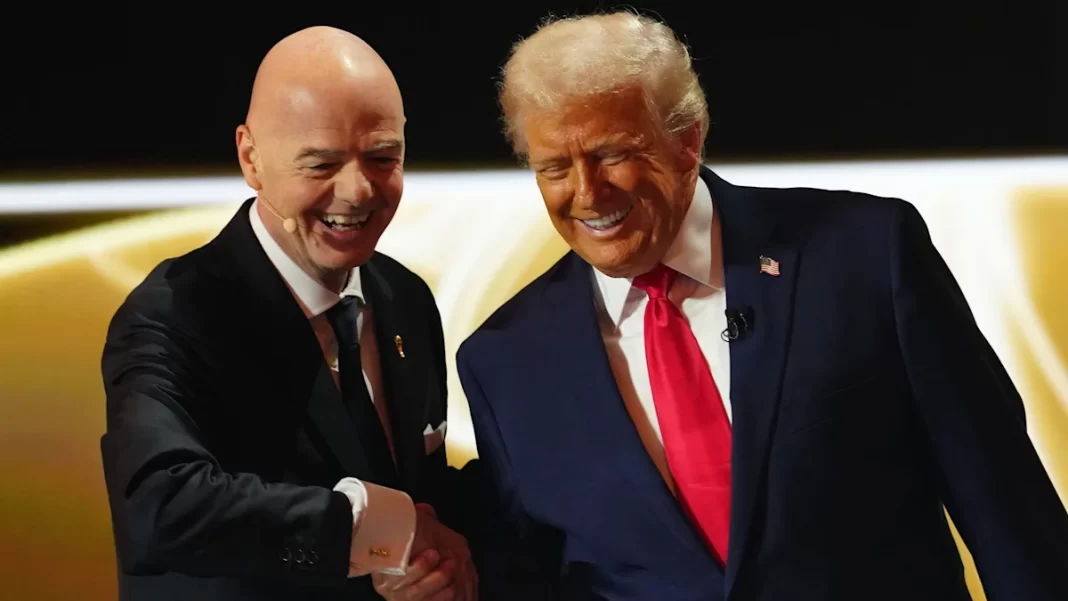
Trump and Infantino, meanwhile, have become unusually close. They have traveled together to Saudi Arabia and Qatar and sat together at the 2025 FIFA Club World Cup Final. Last summer, FIFA leased office space in New York City’s Trump Tower. In December, Infantino gave Trump FIFA’s first-ever Peace Prize. In June, a federal judge dismissed long-running bribery and money-laundering cases involving FIFA after the Justice Department said they no longer fit the Trump administration’s enforcement priorities. And in July, Trump successfully lobbied Infantino to overturn U.S. striker Folarin Balogun’s one-game suspension before the Americans’ Round of 16 match against Belgium.
In light of that relationship — and the various other ways FIFA sought to Americanize this year’s World Cup — some questioned whether a private business deal involving Joshua Kushner and Gianni Infantino might blur ethical lines.
“The close relationship between the FIFA President and the US President has reached a financial dimension that is deeply damaging football,” former FIFA President Sepp Blatter wrote on social media. (Blatter is no stranger to controversy himself.)
In the U.S., Democratic Rep. Jamie Raskin of Maryland — who has already asked Infantino to testify before the House Judiciary Committee about his ties to the Trump administration — accused FIFA in a statement to Politico of “going directly into business with the Trump family” as part of its efforts to curry favor with the president.
“Apparently the fake Peace Prize and giant lease with Trump Tower weren’t enough,” Raskin said.
What’s next?
On Thursday, UEFA said that “no UEFA national teams will participate in any FIFA competition for so long as these proposals remain alive, unless this proposal has been abandoned in its entirety and binding assurances have been given that FIFA will never again open its governance or competitions to private ownership.”
The next FIFA competition is the under-20 Women’s World Cup, which is set to take place in Poland from Sept. 5-27. The Women’s World Cup will follow next summer in Brazil.
Infantino had given FIFA’s 211 member associations until Sept. 19 to vote on his FFE proposal. If the proposal was approved — with the support of a majority of those associations and the FIFA Council — Infantino had promised to double each member association’s funding to $20 million over the next four years, regardless of how they voted. Member associations that voted in favor of the proposal, however, would get $40 million in funding.
The rushed deadline and the offer of extra money “says everything you need to know about this plan,” UEFA said in a statement.
Infantino, for his part, is up for reelection next March, and critics are starting to question whether he can win another term.
“This was an outrageous suggestion,” U.K. Prime Minister Burnham told reporters on Friday. “The idea that it could even be brought forward shows that, in my view, [he] is the wrong man to lead the organization.”
Potential challengers have until Nov. 18 to declare their candidacy.