
Bobby Charles is the Republican nominee for governor in Maine.
The Department of the Secretary of State announced Charles, an attorney from Leeds and former federal government official, won the crowded race after concluding ranked-choice voting tabulations in Augusta after 1:30 a.m. Friday.
Charles will face Democratic nominee Hannah Pingree and independent candidate Rick Bennett, a state senator who was formerly a Republican, in the Nov. 3 general election.
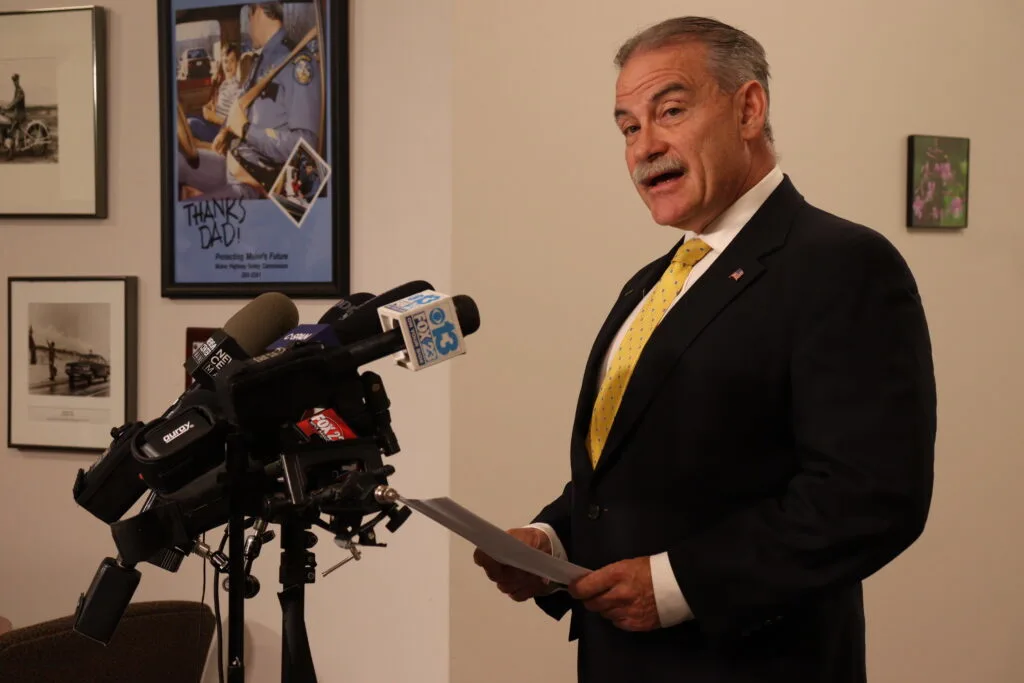
During a press conference outside the tabulation room ahead of the results, Charles criticized ranked-choice voting and said he thinks it gave Bennett a free pass.
“While the two major parties are locked in a drawn-out process, out of their control, waiting for results, unable to pivot to the general, the third-party candidate — today Rick Bennett, tomorrow someone else — is out there running around Maine, completely unencumbered,” Charles said.
Ben Midgley (former president of Planet Fitness) came in second after the final round, and Jonathan Bush (a health technology entrepreneur who is the nephew of the late President George H.W. Bush) came in third. Those candidates were followed by Garrett Mason (former Maine Senate majority leader), Owen McCarthy (a health industry entrepreneur and University of Maine trustee), David Jones (a real estate broker and businessman), and Robert Wessels (a small business owner), respectively.
Candidates who received one of the top three rankings at the end of the second-to-last round of tabulations can request a recount. They have to file a written request with the Secretary of State within five business days.
Ranked-choice voting tabulations were used to determine the winner of the GOP gubernatorial primary and other races where no candidate received more than 50% of the first-choice votes.
Based on first-choice votes, Charles held a lead with 37.9%, followed by Midgley with 20% and Bush with 19.8%.
The ranked-choice tabulations conducted in the Maine Department of Public Safety building began last Friday with staff logging results from every ballot and double checking totals. That took up the bulk of the week-long process, which was livestreamed on the Secretary of State’s YouTube.
As the proofing process stretched into the late hours of Thursday night, an 8 p.m. caffeine run helped energize the secretary’s staff while representatives from the campaigns and other onlookers watched on, some playing cards or reading to pass the time. While the Secretary of State’s Office announced just after 9:15 p.m. that they were anticipating results in two hours, the process dragged on for more than four more hours.
A formatting issue after 1 a.m. and a paper jam after running the tabulation formula marked the last minutes before Deputy Secretary of State Julie Flynn announced the results of the Republican gubernatorial primary first.
The formula eliminates last-place candidates first. In the GOP race, that was state Sen. Jim Libby, who dropped out of the race in April but after the deadline to be removed from the ballot. His votes were redistributed to voters’ next-ranked choice. That process repeated until one candidate received more than 50% of votes.
Will the party rally behind Charles?
There is hesitation from some within the Maine GOP to rally around Charles.
Throughout campaigning, the other Republican candidates aligned on many policy issues but also in collective opposition to Charles, who has run a President Donald Trump-style shock and awe campaign, offering up what his opponents criticized as impossible promises and negative campaigning that heavily relied on social media and artificial intelligence.
During a debate in May, none of the other candidates raised their hands when asked if they would support Charles if he became the party’s nominee. Bush told Maine Morning Star on Election Day that he’d consider Bennett if Charles won the nomination.
Meanwhile, Wessels, who received just 2.7% of first-choice votes, said he plans to fully support whoever ends up with the party’s nomination.
“I have stated it many times publicly and truly believe that any of the seven Republican candidates are far better than Rick Bennett or the five Democrat candidates that were on the ballot,” Wessels said in a statement to Maine Morning Star.
Continued GOP opposition to ranked-choice voting
Ahead of the election, some Republican gubernatorial candidates had embraced ranked-choice voting and encouraged their respective supporters to also rank certain opponents above others. That was notable since many of the state party’s leaders have criticized the process since Maine voters first approved use of the method in 2016.
That is the stance many GOP elected officials, and Charles, doubled down on in the days following the primary.
“This is patently absurd,” Charles said during the Thursday press conference. “No voter should have to wait nine days to find out who won the primary election.”
On social media, Charles ran ads urging Mainers to help “stop the Shenna steal,” referring to Secretary of State Shenna Bellows, who isn’t involved in the tabulation process to avoid any conflict of interest since she also ran in the Democratic primary for governor. During the press conference, Charles said Bellows’ recusal from direct involvement does not change the chain of command.
If elected, he vowed to prevent that from occurring again, and to get rid of ranked-choice voting.
“However things come out this cycle, ranked choice voting is wrong for Maine,” Charles said.
On Tuesday, Charles amplified claims in the conservative media outlet the Maine Wire about missing election materials, which led McBrien to directly address the accusations on the livestream.
McBrien said: Biddeford accidently sent the memory stick with its local municipal ballots instead of the state ballots; a tabulator couldn’t read Bowdoinham’s memory stick so the team decided to scan the paper ballots for that municipality instead; and Bath forgot to include one of its memory sticks when law enforcement originally retired its materials, so officers returned to pick up the remaining item.
When asked about continued Republican criticism of the tabulation process ahead of results Thursday, McBrien reiterated, “The interruptions that we’ve had have actually been very common.”
The timing of when results are available is not only contingent on ranked-choice voting. Maine and a handful of other states don’t have statewide online reporting, instead waiting to release results until after they’re verified at the state level, as reported by the Portland Press Herald.
The League of Women Voters commended the transparency of the tabulation process. However, the organization recommended that the state adopt a policy of providing preliminary results at the end of each day — comparable to what Portland, Oregon, did when it first conducted ranked-choice tabulations in November 2024.
When Maine voters first approved ranked-choice voting by a referendum in 2016, the state became the first to do so. Since then, courts have ruled that the process can’t be used in all statewide elections, because general elections for state offices have to be decided by a “plurality” under the Maine Constitution.
Primary elections and elections for federal offices are governed by state statute and not by the Maine Constitution. That’s why ranked-choice voting is only used in federal races in the general election.