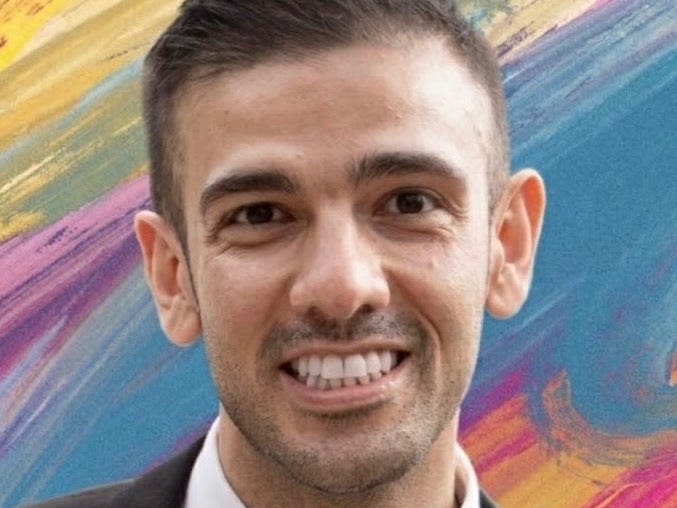


The Democratic establishment had the money, the machinery and the candidate with national name recognition. Angie Nixon had a bookshop called Café Resistance and a grassroots campaign for the Senate. On primary election night in Florida, Nixon won in arguably the biggest upset of the primary season. But at least one person was not shocked: Angie Nixon herself. “We weren’t surprised,” the 42-year-old reflects after overcoming a vast fundraising disadvantage to defeat Alex Vindman, a combat veteran who testified against Donald Trump during his first impeachment. “We actually knew we were going to win; we just didn’t know that we were going to win by that much. We put in the work and so super excited about the outcome. It shows that good old-fashioned grassroots organising will beat big money each and every day.”
Nixon won 56.1% of the vote to Vindman’s 43.9%. The result stirred tensions within the Democratic party in a year defined by the struggle between moderates and economic populists. In Florida – a state that has trended increasingly Republican in recent years and is now Trump’s home state – Democrats have now nominated a member of the Democratic Socialists of America (DSA) who speaks openly about class war.
If elected, Nixon would be the first African American senator in Florida history. She has already cleared numerous barriers to get here, she says by phone. “Money. Racism. People saying I can’t win in the state because I’m a Black woman. People regurgitating talking points. All the things.”
Nixon was born and raised in Jacksonville, primarily by a single mother who worked two jobs to put food on the table. Her father, an army veteran, was not always present. “None of my parents were involved in politics,” she recalls. “My mom, though, was a union member and so that’s where I learned about the power of organising.
“I remember my mom telling me she was on strike and I overheard her conversations talking about scabs in the union and people crossing the picket line. I am someone who grew up knowing the importance of solidarity with your fellow workers and people who were being oppressed and whatnot.”
Nixon’s youth was shaped by the systemic failures of public institutions. She was bussed across town to elementary school because her predominantly Black neighbourhood school lacked resources. Later her family suffered a devastating tragedy when her favourite cousin was killed by gun violence.
After graduating from the University of Florida in 2007, Nixon became a union organiser with the Service Employees International Union. What she witnessed convinced her that the professional political class is fundamentally out of touch with ordinary Americans.
Nixon says: “Working families are getting the short end of the stick. They are oftentimes being exploited and they’re the ones that actually make the profits and drive the economy. Meanwhile the billionaires and the corporations and the CEOs get all the credit.”
In 2020 she was elected to the Florida house of representatives, where she has pushed for expanding childcare and stopping a major grocery chain from gouging their prices. In May this year she protested against the Republican-controlled legislature’s redistricting of the state’s congressional maps by shouting through a megaphone on the house floor, earning a reprimand from an ethics committee. After Governor Ron DeSantis approved the gerrymander, she staged a sit-in at his office and was arrested.
Nixon also sued the state after being denied access to the south Florida migrant detention centre known as “Alligator Alcatraz”, and introduced legislation that would require Immigration and Customs Enforcement (ICE) and other US law enforcement agents to unmask and identify themselves on the job.
Why did she decide to take the fight to the national stage? “Because people are struggling, people are snapping, people are losing their minds, people are taking their lives. People can’t even enjoy just being alive any more. They’re just working to live.“
In her Senate campaign Nixon proposes fixes such as the Medicare for All universal healthcare plan, universal childcare, a national rent freeze and moratorium on evictions, stronger union protections and a federal minimum wage of $25 an hour. She proposes higher taxes on billionaires, driving big money out of politics and reining in tech companies and datacentres.
In June Nixon joined the DSA, whose more than 100,000 members include Zohran Mamdani, elected mayor of New York City last year. Candidates associated with the DSA have pulled off notable wins in recent House of Representatives primaries.
Nixon explains: “They are an organisation that was pushing and fighting for the same things that I was fighting for. I don’t agree with everything that they agree with, but they’re fighting hard to ensure we have access to universal healthcare, access to free college and fully funded public schools.
“Unfortunately, the Democratic party isn’t fighting as hard as they should, at least those elected officials, and so I decided to join them because I’ve been on the frontlines fighting as well and I want people who are actually going to get to work.”
Nixon believes that, even if she had not joined the DSA, she would have won the election anyway – pointing out that the DSA did not endorse her, and that she also joined the progressive Working Families party. But would she describe herself as a democratic socialist?
“I would describe myself as a former single mama who is putting my family and my community first. I am a Democrat. I’ve always been a lifelong Democrat but I’m more of social democrat who believes in strong safety nets.”
While Nixon performed strongly in working-class, majority-Black counties, she was notably weaker in south Florida’s Latino communities, where historical experiences with leftwing authoritarian regimes make the socialist label highly polarising. Nixon resists being put in a political box.
She comments: “We can argue about labels each and every day but I care about people’s needs and I’ve never been able to fit in one box but, as I do more research, I see that I’m aligned with what folks have referred to as ‘the FDR [Franklin Delano Roosevelt] Democrats’. He’s someone who believes in social programmes and I believe in social programmes, especially if the current economy isn’t working for everyone.”
But Democratic establishment figures are worried that nominating a DSA member will backfire in conservative Florida. The internal friction was laid bare shortly after Nixon’s victory when reports emerged of a heated, shouting phone call between her and the Florida Democratic party chair, Nikki Fried. At one point Nixon yelled, “Stop gaslighting me!”, a source told the Axios news site.
Nixon does not deny the incident, describing the tension as a natural feature of a broad coalition.
“Sometimes you argue with your siblings because you want to do things a certain way and they may want to do things a certain way and at the end of the day you are all going to move in the direction to help benefit your family. Our family is the community of Florida and so she and I are together. There’s no ill will among us. We are going to do what we need to do to make this state and country better.”
Nixon’s populist economic message faces an uphill battle in November, when she goes head-to-head with the Republican senator Ashley Moody, a former state attorney general appointed by DeSantis to fill Marco Rubio’s vacant Senate seat. Whereas active registered Democrats outnumbered Republicans in the state in 2020, there are now 1.5 million more Republicans than Democrats.
Republicans have already begun framing Nixon’s victory as a gift. Congresswoman Anna Paulina Luna told Fox News that Nixon’s nomination “will bring Republicans out to vote specifically against her because of the fact they don’t want her radical policies”. Senator Tim Scott of South Carolina called the Democratic left wing “dangerous, radical and, frankly, weird”.
Progressives, however, argue that a bold, authentic economic message is the only way to reverse the party’s decline in the state. They point to the recent Miami mayoral race, where Eileen Higgins campaigned openly as a Democrat despite the race being officially nonpartisan and defeated Trump-backed Emilio Gonzalez, marking the first Democratic mayoral victory in Miami in nearly 30 years.
No political campaign in Florida is fought outside the shadow of Trump, whose Mar-a-Lago estate is in Palm Beach. The president gleefully celebrated Vindman’s defeat, calling him a “treasonous creep” and predicting “certain defeat” for “Radical Left Lunatic” Nixon in November.
In her eyes, Trump’s influence represents a clear and present danger to democracy. “I’m concerned with whether this country is still going to be standing because we have someone who does not want to leave the White House. We have someone who is creating a paramilitary force and creating basically an underground ballroom-bunker type situation.
“I’m concerned about that and I want to go to Washington DC to put a check on his corruption and his power to let him know that he is not a king. We did not appoint him to be a king.”