
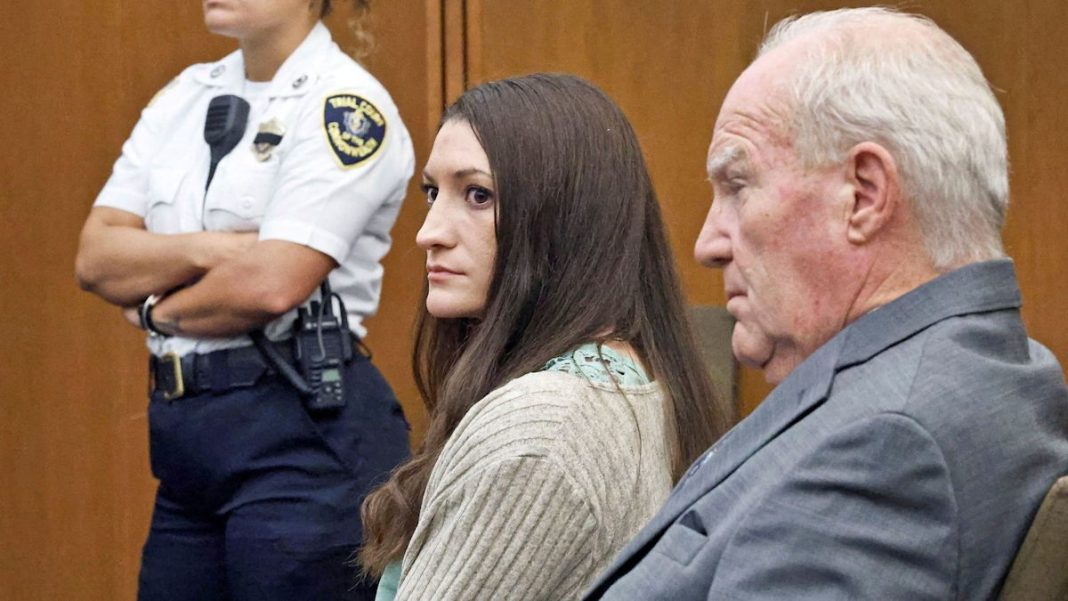

After days of deliberating without a verdict, the jury in the Lindsay Clancy murder trial will come back for a seventh day of deliberations on Friday morning. In a dramatic series of events on Thursday afternoon, Clancy’s defense attorney said there is one juror who is preventing the panel from reaching a unanimous verdict.
The 12-person jury in Plymouth, Mass., made up of nine women and three men, is determining whether Clancy is criminally responsible for her actions when she killed her three children in 2023. Clancy, 36, has admitted to strangling her children — Cora, 5; Dawson, 3; and 8-month-old Callan — at their Duxbury, Mass., home in January 2023. However, she has pleaded not guilty to three counts of first-degree murder.
Day six of deliberations included a heated exchange among counsel
On Thursday afternoon, Judge William Sullivan received a note from the jurors, signaling that there may have been movement on a verdict or that they remained deadlocked.
Instead, the note prompted the judge to go into a sidebar with the defense and the prosecution — with defense attorney Kevin Reddington visibly frustrated, and bringing Clancy to join the discussion midway through. Soon after, each juror was brought to the bench one by one to be sworn in. The judge later re-instructed them on what would constitute reasonable doubt. With about half an hour left in the day, Sullivan then sent the jury back to continue deliberating.
Without the jury present, Reddington moved to have the holdout juror removed, saying the note from jurors indicated that “there’s one juror who refuses to listen to the law that you’ve given him or her on reasonable doubt.”
Sullivan declined to remove the holdout juror.
“If we come back here in half an hour with a mistrial because of a juror that has just spurned the instructions of this court, it’s a shame,” Reddington told the judge.
The prosecution told the judge they had no objection to the jury’s questions or the instructions given to them.
“We have the note from the jury. There’s no way to determine what the deliberations are. Who’s correct, who’s incorrect,” the prosecutor said. “Nor should we attempt to, because that’s part of deliberations.”
The tense unfolding of events on Thursday comes one day after the judge read the Tuey-Rodriguez charge to the jury. It’s a special, final instruction to jurors in Massachusetts that asks them to consider the reasonableness of all opinions.
As of the end of day six, jurors have been roughly deliberating for over 36 hours.

Judge William Sullivan looks over the courtroom at the start of the session on Thursday.
(Greg Derr/The Patriot Ledger/AP)How we got here
Reddington’s request came as the jury continued to remain deadlocked after more than 35 hours of deliberations.
The trial is unusual for a murder case because the question of whether Clancy killed her three children is not disputed. She has admitted to strangling all three at their home in January 2023. What the jury has been asked to consider is whether she was of sound enough mind to be held criminally responsible for their deaths.
Clancy’s defense team has argued that she was suffering from postpartum psychosis, a rare mental illness that they say made her unable to understand the wrongfulness of her actions.
Prosecutors contended that Clancy, who was never formally diagnosed with the condition, carefully planned the killings and bears full responsibility for her children’s deaths.
The course of Clancy’s mental health decline in the months leading up to the killings was a central topic throughout the trial. Her ex-husband and other close family members testified that her condition deteriorated rapidly in the months following the birth of her third child. Her former mother-in-law told the jury that she was “begging for help” as she dealt with symptoms of depression, anxiety and severe insomnia.
Several medical professionals who treated her during this period testified that, though she was clearly struggling, Clancy did not show signs of the type of dangerous psychosis her defense claims she was experiencing.
“I did not have any concerns about her safety or her risk for anybody else,” said Dr. Alia Goodheart, a psychiatrist who led Lindsay’s care during her inpatient hospital stay in early January 2023.
There were also competing analyses from psychiatric experts who either met with Clancy after the killings or reviewed her medical records.
Dr. Paul Zeizel, a clinical and forensic psychologist who was called to the stand by the defense, testified that Clancy was unable to appreciate the “wrongfulness” of her actions.
“She was unable to conform her behavior to the rule of law. She had no appreciation for the wrongfulness of her act,” he said.
Dr. Avram Mack, the psychiatrist called by the prosecution, gave a sharply different view.
He said Clancy had experienced a “major depressive episode as part of major depressive disorder,” but that her condition did not rise to the level of psychosis.
“My opinion is that she retained the capacity … required for having criminal responsibility for these actions,” he said.
The jury began deliberating on Aug. 27. On Tuesday, after days of inactivity, they sent Judge Sullivan a note telling him that they were deadlocked. He instructed them to continue deliberating. A second notice of an impasse came the next day. Again, Sullivan told them to keep working to reach a verdict.
Under Massachusetts law, the case would automatically end in a mistrial if the jury reports that they are deadlocked a third time.
What happens next?
The jury will return for deliberations on Friday morning at 9 a.m. ET. Reddington told reporters while leaving court on Thursday that the holdout juror has been identified and there will be an inquiry by the judge when the court is in session on Friday.
If the jury again informs the judge that they are unable to reach a verdict, the trial will be over. It’s unclear whether prosecutors intend to retry the case in the event of a mistrial or whether Clancy might remain in custody while the case remains unresolved.